

“Only I can change my life. No one can do it for me.” Carol Burnett
“You can do anything you decide to do.” Amelia Earhart
Vitamin B Complex: Supplementing with a Vitamin B Complex is frequently done to augment our nutritional intake. Our genetic machinery can not produce vitamins, so we must obtain them from our diet for human health. B vitamins are the backbone of many different and complete physiological processes, including the brain. This knowledge empowers us to understand the crucial role B vitamins play in our health, whether in the absence or presence of Parkinson’s.
The brain under attack from Parkinson’s needs help to reinforce a depletion in vitamins and other cellular constituents. Thus, taking a vitamin B complex supplement is considered safe and effective. B vitamins are water-soluble, which says we can typically safely tolerate more significant amounts of B vitamins than recommended for our daily allowance.
“I am not a product of my circumstances. I am a product of my decisions.” Stephen Covey
Role of B Vitamins in the Brain: B vitamins generally function in the brain like in the rest of the body. There are eight B vitamins: B1 (thiamine), B2 (riboflavin), B3 (niacin), B5 (pantothenic acid), B6 (pyridoxine), B7 (biotin), B9 (folate), and B12 (cobalamin). Here are some essential functions for each B vitamin.
•B1 (thiamine) is involved in the pentose phosphate shunt, integral to synthesizing fatty acids, steroids, nucleic acids, and amino acid derivatives for numerous neurotransmitters.
•B2 (riboflavin) is a coenzyme for two flavoproteins (FMN and FAD) essential for recycling niacin, folate, and vitamin B1. These proteins are also involved in essential fatty acids in brain lipids.0
•B3 (niacin)- derived nucleotides (NAD and NADP) are involved in many cellular processes, including energy production, oxidative reactions, antioxidant protection, DNA metabolism, and repair.
•B5 (pantothenic acid) synthesizes the all-important coenzyme (CoA).
•B6 (pyridoxine) helps synthesize neurotransmitters dopamine, serotonin, g-aminobutyric acid, noradrenaline, and melatonin.
•B7 (biotin) is involved in the delivery and metabolism of glucose.
•B9 (folate) and B12 (cobalamin) are linked together by the folate and methionine cycles, which are essential for the conversion of amino acids to monoamine neurotransmitters, serotonin, dopamine, melatonin, noradrenaline, and adrenaline.
“To change a habit, make a conscious decision, then act out the new behavior.” Maxwell Maltz
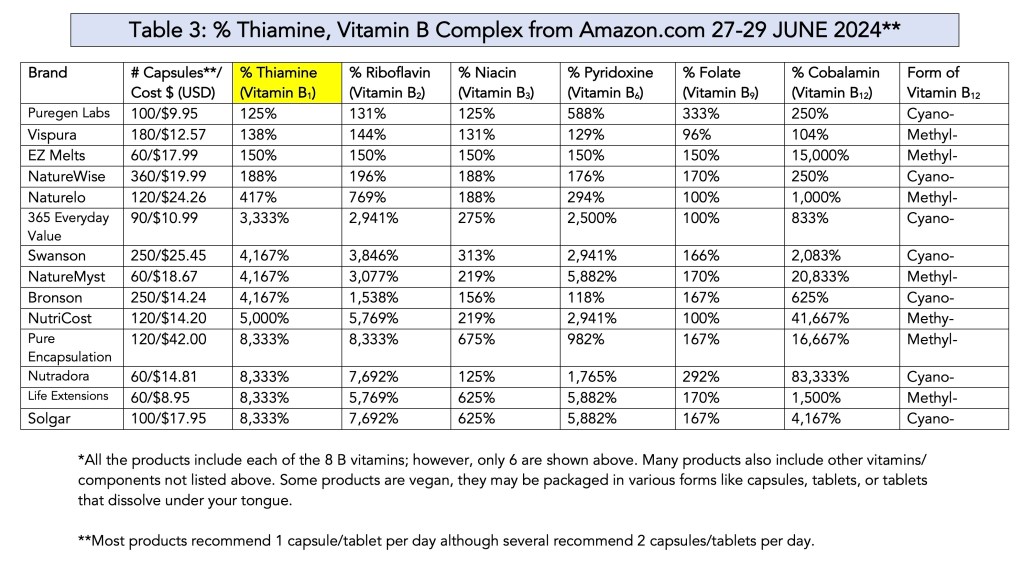
Many Different Types of Vitamin B Complex on the Market: I have used a specific brand of Vitamin B Complex for over a year: “EZ Melts” Vitamin B Complex. And since I just completed my annual check-up about the supplements I was taking (click here), it was an excellent time to take inventory and re-assess the various brands of the vitamin B complex. A few things to keep in mind: here are 14 different products (there are many more to choose from), and these are all available from Amazon.com. Most of these products recommend one capsule/tablet daily, but some suggest two. All of the products listed here contain all eight of the 8 vitamins, although, for simplicity, I have presented only six of them, B1 (thiamine), B2 (riboflavin), B3 (niacin), B6 (pyridoxine), B9 (folate), and B12 (cobalamin),
Click here to download the 3-page handout of Tables 1-3 in PDF format.
I do not doubt that all of these products are good regarding the content and quality of vitamin B complex. Although each individual may require a vegan product, capsule over tablet, and so forth, many reasons exist to consider any of these products.
The Table showing the 14 different vitamin B complexes is presented in 3 distinct variations: first, it emphasizes vitamin B6 (pyridoxine) (Table 1); second, it highlights the type and amount of vitamin B12 (cobalamin) (Table 2); and finally, it highlights the amount of vitamin B1 (thiamine) (Table 3).
Importance of Choosing the Appropriate Vitamin B Complex:
A) Understand the importance of vitamin B6 (pyridoxine) in the supplement- Not discounting the vital role played by vitamin B6, one must be careful with Parkinson’s if you are taking Carbidopa/Levodopa. High amounts of Vitamin B6 will modify and inactivate carbidopa, so it no longer protects the circulation of levodopa throughout the peripheral bloodstream. It will lead to a loss of levodopa, which can be converted to dopamine in the brain. One can take carbidopa/levodopa and vitamin B6 separated by several hours or choose a brand of vitamin B complex supplement that is <250% vitamin B6,. See Table 1 for a detailed look at 14 different Vitamin B complex formulations focused on vitamin B6.
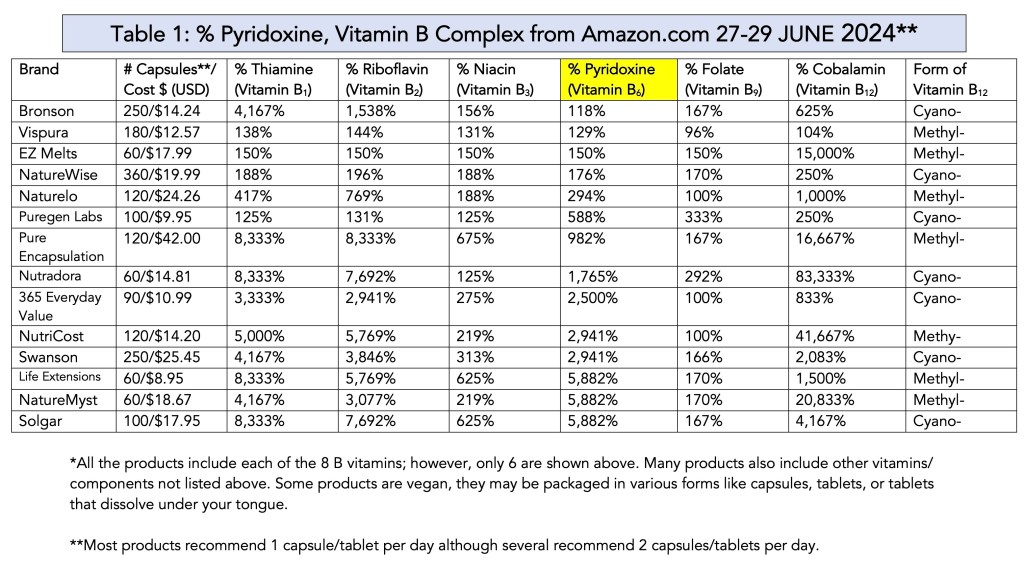
B) How much and what form of vitamin B12 should you take in your vitamin B complex supplement?- Cobalamin is a very complex substance with a cobalt molecule in its molecular structure (vitamin B12 is pinkish in color). Methylcobalamin is the natural form of vitamin B12, and cyanocobalamin is synthetic. The two forms also differ in structure—methylcobalamin contains a methyl group, and cyanocobalamin contains a cyanide compound. Both forms are found in supplements; however, the cyano-form is more prevalent due to cost and increased stability. There is a wide range of amounts of vitamin B12 for all the B vitamins, with methylcobalamin ranging from 104-20,833% and cyanocobalamin ranging from 250-83,333%
If one has kidney disease, the B12 is broken down there; thus, take the methyl-form instead of the minimal amount of cyanide released in the cyano-form. We store very little vitamin B12. To help, we have many different pathways to absorb it from our digestive tract. However, some people have problems capturing it in their gastrointestinal tract; thus, using a sublingual tablet and directly absorbing the vitamin B12 into your bloodstream is an advantage. See Table 2 for a detailed look at 14 different Vitamin B complex formulations highlighting the amount and form of vitamin B12 .
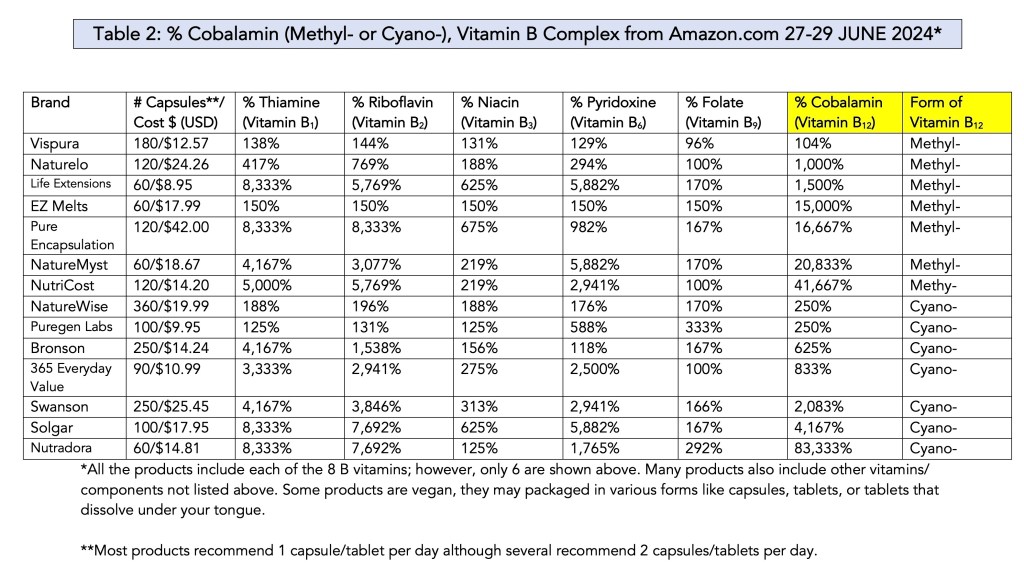
C) If you are following an HDT regimen, consider this when looking for the amount of vitamin B1 (thiamine) in your vitamin B complex– Many people with Parkinson’s have tried and adopted the high-dose thiamine (HDT) regimen from the renowned Neurologist, Dr. Costantini, which supported the use of large doses of thiamine. Please note that 100 mg of vitamin B1 is 8,333% of the daily value needed (see Table 3, below). Recently, Dr. Daphne Bryan has a large group of followers with a slightly modified vitamin B1 protocol. Thus, knowing how much thiamine is in your vitamin B complex supplement is crucial if one is using either protocol.
“It does not take much strength to do things, but it requires great strength to decide on what to do.” Elbert Hubbard
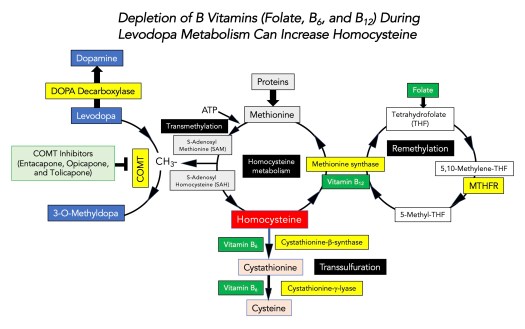
The Neurotropic B Vitamins: Of the B vitamins, B1, B6, and B12 are vital in their roles in the brain. They have been frequently termed the neurotropic B vitamins. Besides its role in metabolism, vitamin B1 has an antioxidative effect. Vitamin B6 is crucial for amino acid metabolism, including synthesizing neurotransmitters. Vitamin B12 is also critical in helping to synthesize the myelin sheath on nerves. Additionally, vitamin B12 and folate are essential members of the methionine cycle, which shows that a deficiency of either B vitamin will lead to homocysteine accumulation. It is thought that B1, B6, and B12 have a synergistic process between the three B vitamins during nerve regeneration..
When you have collected all the facts and fears and made your decision, turn off all your fears and go ahead!” George S. Patton
Summary of Past Blog Posts on the B Vitamins: In 2017, I published the blog post “B Vitamins (Folate, B6, B12) Reduce Homocysteine Levels Produced by Carbidopa/Levodopa Therapy” (click here), which summarized the biochemistry of how B vitamins reduce the detrimental build-up of homocysteine due to Carbidopa/Levodopa therapy. More recently, I revisited and expanded the story with the blog post “Revisiting the Role of B Vitamins to Reduce Homocysteine Levels Generated from Levodopa Therapy of Parkinson’s” (click here). And the figure below aptly summarizes the complexity (and biochemical beauty) of these B vitamins to regulate the production of homocysteine. Finally, I wrote about “Parkinson’s: Signs and Symptoms of Either a B Vitamin Deficiency or Overload” (click here).
“You cannot make progress without making decisions.” Jim Rohn
Summary:The original thought was to make this a concise show-and-tell blog post about 14 different vitamin B complex products. Well, it is longer than planned, but a description of the B vitamins and why we take them was essential to include. I am not a salesman nor receive any kickback from Amazon.com for discussing any product. That was never the goal. There is a wide range of individual B vitamin complex products. I highlighted some features to consider when choosing a vitamin B complex supplement.
If you opt out of taking a vitamin B complex supplement, please ensure you get adequate amounts of vitamin B1, B6, and B12 (including folate) in your diet, at least the daily suggested amounts. The good news about the idea behind the vitamin B complex supplement is that it usually requires only one capsule/tablet daily.
Stay focused on managing (and understanding) how you feel each morning you wake up and every hour afterward until you fall asleep later that evening. Managing your Parkinson’s and its myriad of symptoms is not a part-time position. Stay healthy, and good luck!
“A rule of thumb for a warrior is that he makes his decisions so carefully that nothing that may happen as a result of them can surprise him, much less drain his power.” Carlos Castaneda
Useful References:
Calderón‐Ospina, Carlos Alberto, and Mauricio Orlando Nava‐Mesa. “B Vitamins in the nervous system: Current knowledge of the biochemical modes of action and synergies of thiamine, pyridoxine, and cobalamin.” CNS neuroscience & therapeutics 26, no. 1 (2020): 5-13.
Kennedy, David O. “B vitamins and the brain: mechanisms, dose and efficacy—a review.” Nutrients 8, no. 2 (2016): 68.
Selhub, Jacob, Aron Troen, and Irwin H. Rosenberg. “B vitamins and the aging brain.” Nutrition reviews 68, no. suppl_2 (2010): S112-S118.
Baltrusch, Simone. “The role of neurotropic B vitamins in nerve regeneration.” BioMed Research International 2021, no. 1 (2021): 9968228.
Calderón‐Ospina, Carlos Alberto, and Mauricio Orlando Nava‐Mesa. “B Vitamins in the nervous system: Current knowledge of the biochemical modes of action and synergies of thiamine, pyridoxine, and cobalamin.” CNS neuroscience & therapeutics 26, no. 1 (2020): 5-13.
Calderón‐Ospina, Carlos Alberto, and Mauricio Orlando Nava‐Mesa. “B Vitamins in the nervous system: Current knowledge of the biochemical modes of action and synergies of thiamine, pyridoxine, and cobalamin.” CNS neuroscience & therapeutics 26, no. 1 (2020): 5-13.
Cover Photo Image by Robert Waghorn from Pixabay
 Journey with Parkinson's
Hi Frank,gre
LikeLike