

“Sleep is a hint of lovely oblivion.” D. H. Lawrence
“A ruffled mind makes a restless pillow.” Charlotte Bronte
Introduction: In a recent review, Antelmi et al. (2025) predicted that ~90% of individuals with Parkinsons are affected by one or more sleep disorders [Antelmi, E.; Lanza, G.; Mogavero, M.P.; Mingolla, G.P.; Plazzi, G.; Ferini‐Strambi, L.; Ferri, R.; Tinazzi, M. Intersection of sleep disorders and Parkinson disease: unveiling the bidirectional relationship. Movement disorders clinical practice 2025, 12, 11-20].
Individuals with Parkinson’s are frequently known to have issues with sleep, including insomnia, excessive daytime sleepiness, circadian dysfunction, restless legs syndrome, Rapid Eye Movement (REM) Sleep Behavior Disorder (RBD), and obstructive sleep apnea (OSA). OSA is repeated obstruction of the upper airway during sleep, and if left untreated, is associated with cognitive dysfunction. The link between OSA and Parkinson’s is somewhat controversial. Nonetheless, there remains substantial interest in understanding the association between OSA and Parkinson’s. And the results from this study are interesting.
“The best eraser in the world is a good night’s sleep.” Orlando Aloysius Battista
Study Design: The study described here by Neilson et al. (2025) was organized and performed by the Portland VA Medical Center. There were two goals: first, to study the link between OSA and Parkinson’s; and second, to determine if the association between OSA and Parkinson’s is lessened by CPAP (continuous positive airway pressure) treatment.

The power in this study is the sheer number of people analyzed, the careful precision used to diagnose OSA in the veterans, and the reasoning applied to those patients who did use CPAP therapy. If you read the paper, it is just a bunch of numbers and percentages, and it comes across as just a matter of statistics. However, the drama is in their interpretation of their results. To steal their thunder: If you are relatively young and have been diagnosed with OSA, starting CPAP therapy is strongly recommended, as it could reduce the incidence of Parkinson’s and potentially alter the progression of the disease.
“A well-spent day brings happy sleep.” Leonardo da Vinci
Results: All veterans who received VA care were eligible, but they excluded veterans younger than 40 years. A total of 11,310,11 participants were included in the study.
From this group, they found that 1,552,505 had OSA, and 144,643 veterans had a record of using CPAP. Those veterans with OSA had a greater mean BMI (body mass index).
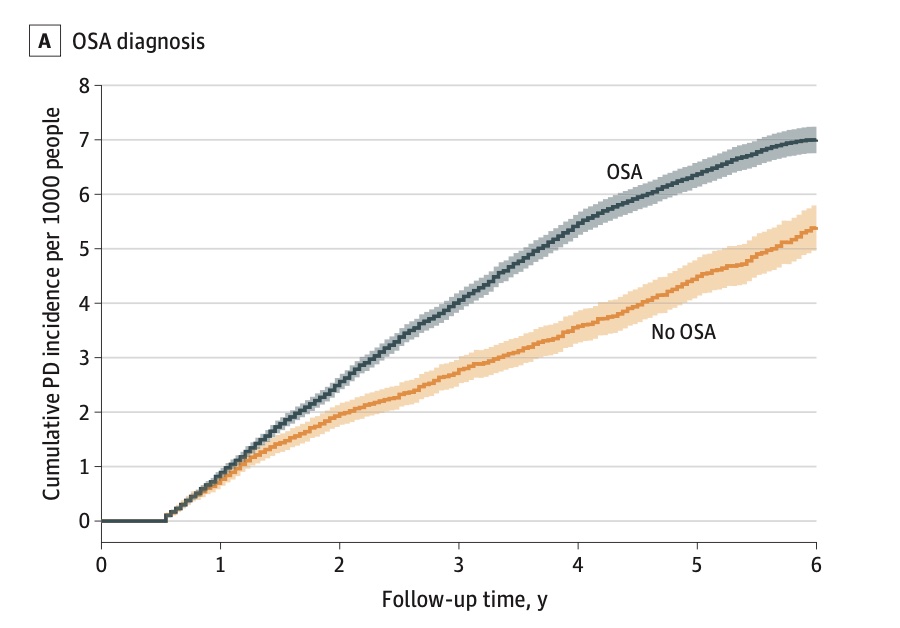
This cohort (a group tracked over time in a study to see how certain factors affect them) was followed for 4.9 (+/- 1.8) years. Veterans with OSA showed a greater incidence of Parkinson’s compared to the group without OSA. This is shown in the figure below, plotting follow-up time in years on the x-axis and PD occurrence per 1000 people on the y-axis. The OSA-positive group in gray shows an increased rate of Parkinson’s.
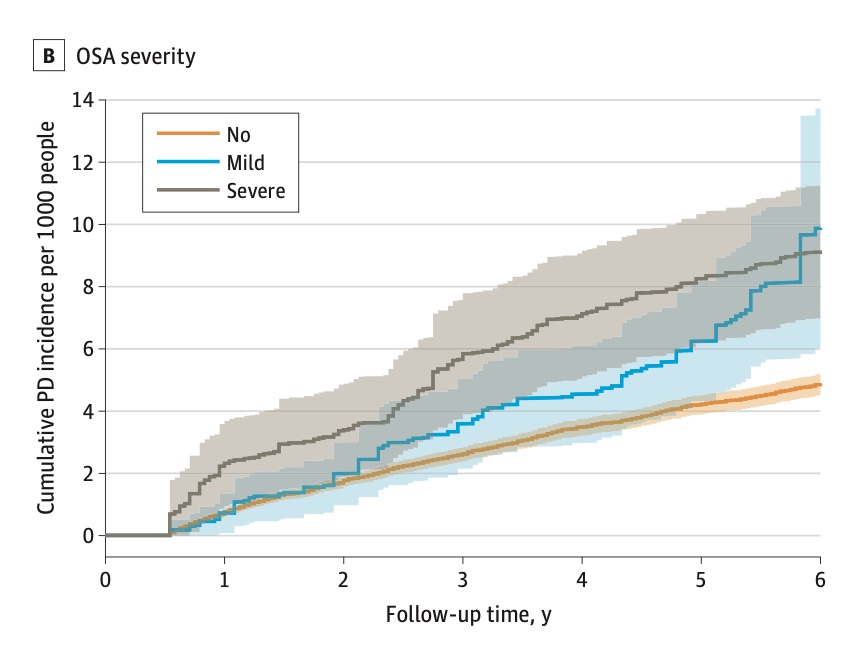
The investigators next looked at the severity of OSA and the incidence of Parkinson’s. As shown in the figure below, the more severe the OSA, the higher the incidence of Parkinson’s. In the figure, the data plotted in yellow/gold represent no OSA, mild (blue line), and severe (brown) OSA, and both show a higher incidence of Parkinson’s.
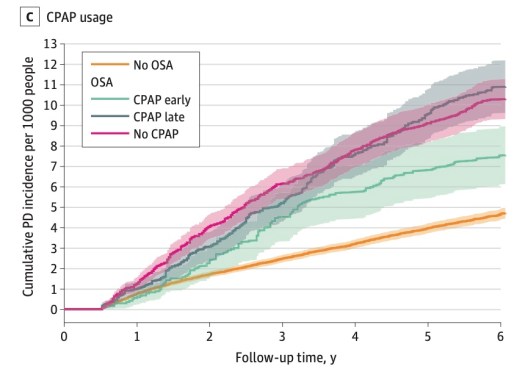
CPAP is an approved treatment for controlling breathing in patients with OSA while they sleep. Therefore, they next studied those veterans diagnosed with OSA and the use of CPAP therapy. The figure below shows this data; look at it carefully. The no OSA is plotted in yellow/gold, and no CPAP therapy is given in red- this shows similar data to the first figure. Interestingly, when CPAP was used early after the diagnosis (green line) compared to later after the diagnosis (brown line) revealed two things. Early use of CPAP (green line) reduced the incidence of Parkinson’s, while later use of CPAP (blue line) showed less of a change in Parkinson’s occurrence. A further look at their data showed that early use of CPAP reduced the risk of Parkinson’s in male veterans; however, this protection was not seen for female veterans.
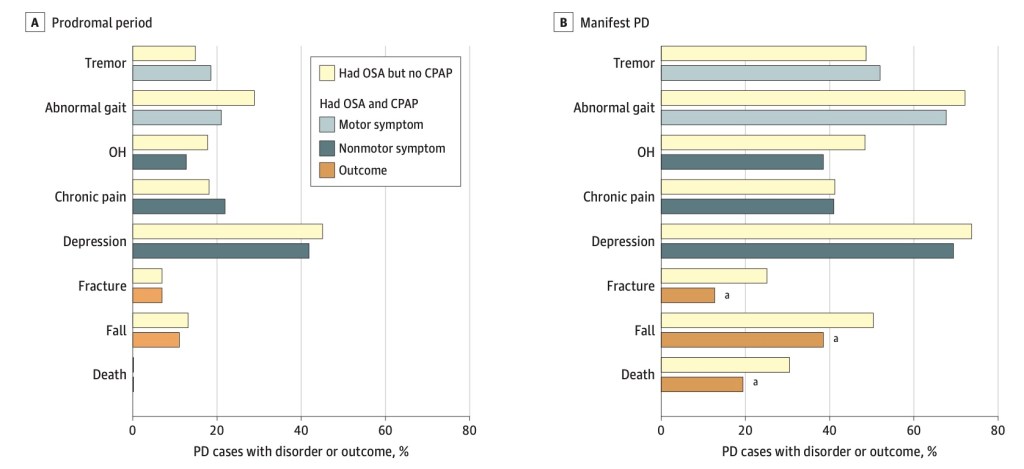
They then looked at some health factors by examining the proportion of motor and non-motor symptoms and various other events (e.g., falls, fractures, death) in the OSA groups with and without CPAP. The figure below displays this information. On the left side, in the prodromal period, no differences were found. However, once Parkinson’s was diagnosed (right side), there were no statistically significant differences in motor or non-motor symptoms; yet, there were statistical differences in rates of falls, fractures, and deaths for those OSA patients with early CPAP use.
Please note that the authors presented significantly more information and data in their paper than described here. To explain the importance of their study, I have used fewer data sets than presented by the authors. You are encouraged, if interested, to read the entire article, including the Supplemental results.
“I love sleep. My life has the tendency to fall apart when I’m awake, you know?” Ernest Hemingway
Major Findings of this Study:
•Veterans with OSA showed a greater incidence of Parkinson’s.
• This difference was noted as early as the 2-year follow-up.
•They found that the severity of OSA was related to the incidence of Parkinson’s.
•Importantly, the use of CPAP within 2 years of OSA diagnosis lowered the risk of Parkinson’s.
•Their data suggests that early CPAP adherence may contribute to benefits once Parkinson’s has commenced following diagnosis.
•A limitation of their work was that although they found that CPAP lowers the risk of developing Parkinson’s, they were unable to assess CPAP adherence.
“I count it as a certainty that in paradise, everyone naps.” Tom Hodgkinson
Conclusions:
OSA seemed to be an independent risk factor for developing Parkinson’s later and could be influenced by early CPAP treatment. Therefore, implementing effective screening methods and adherence protocols for CPAP may greatly benefit brain health.
Veterans experiencing daytime fatigue or a history of snoring should reach out to their local VA medical center to request obstructive sleep apnea screening and a CPAP evaluation. Additionally, veterans can file a claim for OSA as a secondary condition if Parkinson’s has been established as a primary service-connected condition.
“I had a new idea in my head… this time it’s just simply my bedroom, only here colour is to do everything, and, giving by its simplification a grander style to things, is to be suggestive here of rest or of sleep in general. In a word, to look at the picture ought to rest the brain or rather the imagination.” Vincent Van Gogh
Cover photo image by Jason Reid from Pixabay

