
“Exercise of the muscles keeps the body in health, and exercise of the brain brings peace of mind.” John Lubbock
“Physical fitness can neither be acquired by wishful thinking nor by outright purchase.” Joseph Pilates
The Beginning: Scott C. Newman founded Rock Steady Boxing in 2006 after he was diagnosed with Parkinson’s disease at age 40. Together with others, including former Golden Gloves boxer Vince Perez and professional boxer Kristy Rose Follmar, they soon formed a nonprofit organization, and Rock Steady Boxing was born.
“Ability is what you’re capable of doing. Motivation determines what you do. Attitude determines how well you do it.” Lou Holtz
My Beginning with Rock Steady Boxing (RSB): Several years before I left Chapel Hill, NC, a group started an RSB chapter in Durham, NC. I thought it was a great idea at the time, but after attending twice, I realized the drive was long, and the classes didn’t fit my work schedule, so I stopped going. And that was my loss.
As we move into spring 2026, I have just returned from a great trip to Vermont and Maine, and I realized a couple of things. I had just come through a year of having both hips replaced with titanium joints, having cataract surgery, and having a colonoscopy, and the year before that, I had another orthopedic knee surgery to remove torn cartilage. This had me in a downhill mental rut, but physically, I had nothing to complain about. I should have been working hard and exercising, but I didn’t feel satisfied with my effort. I needed a change.
I had heard great things about RSB here in Bluffton/Hilton Head Island, so I called my friend Brett, who I knew was a regular participant. We met the first Tuesday after returning from Maine, and I met John, who ran the group, at his gym, Riptide MMA (Mixed Martial Arts). John introduced me to the group present for that morning’s workout, and we started. An hour later, I could barely talk. I was exhausted, and that’s how I started my relationship with RSB.
“The secret of getting ahead is getting started.” Mark Twain
The Goal of Rock Steady Boxing: Every gym that offers RSB classes will be different. While everyone trains in the home base city of Indianapolis, instructors apply that knowledge of RSB basics to teach their classes. RSB at Riptide MMA of Bluffton/Hilton Head Island meets Monday-Thursday, 10:00-11:00 AM, with Friday as an optional workout day.
About 35-40 members are active, and there are 3 instructors. Each day is different for us, but the result is always the same. The hour of RSB leaves me virtually speechless, in a state of wonder that I did it, and then I need to get to my car, drive home, renew, and live the rest of the day. It is a powerful experience to do daily, and I try hard to attend every day, hopefully at least 4 times/week, because it’s that important to me now.
“Not less than two hours a day should be devoted to exercise.” Thomas Jefferson
Understanding Rock Steady Boxing Requires Introducing Exercise-Induced Exerkines: As your muscles and body move during exercise, numerous organs and tissues synthesize and secrete substances called exerkines. Some of these exerkines cross the blood-brain barrier and activate specific receptors in your brain. The illustration below provides an overview of how exercise generates exerkines and how some reach the brain. You can see why so many say, “exercise is medicine,” and one key player is exerkines.
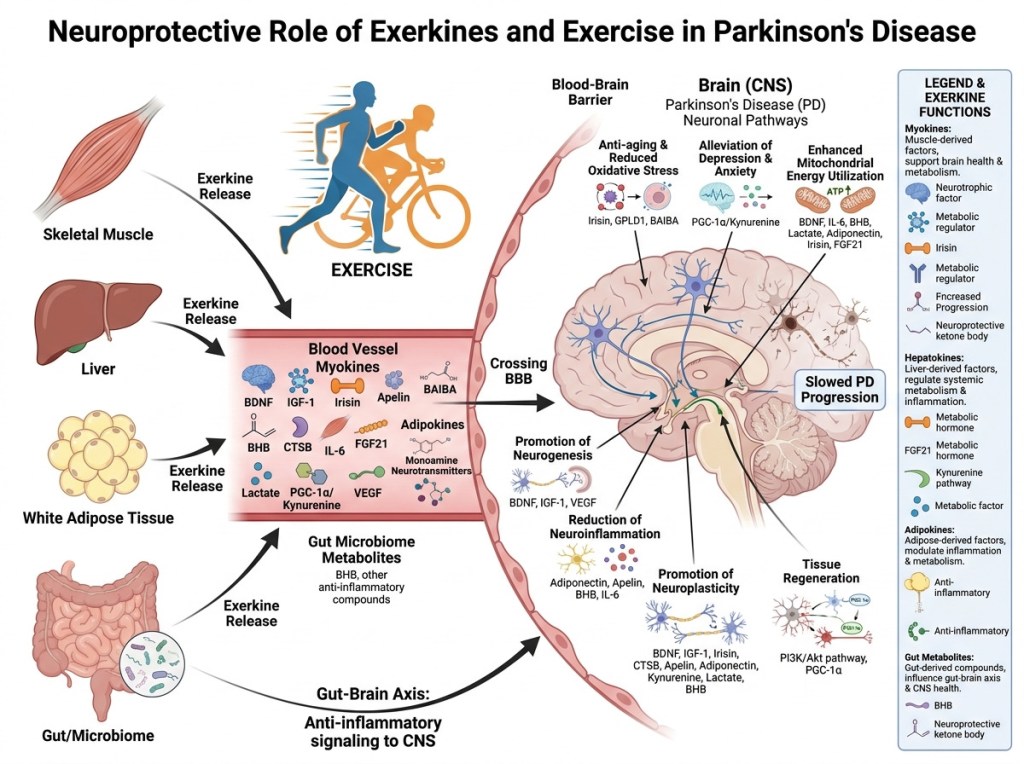
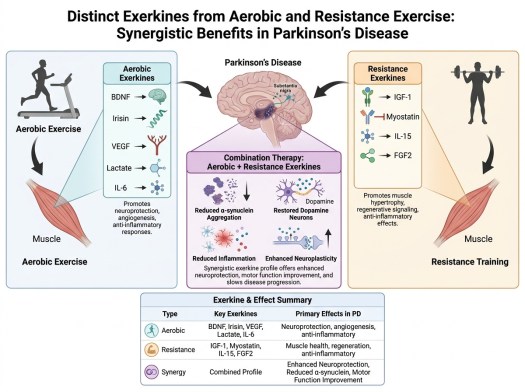
One of RSB’s training benefits is its ability to balance aerobic exercise, resistance training, and high-intensity interval training (HIIT). Sometimes you are boxing and hitting a bag; other times you’re running; often, you are swinging weighted ropes; using TRX straps or moving a weighted dummy; and at other times you are throwing a medicine ball or using dumbbells or a kettlebell. Some exercises have a cognitive angle, and when you are tired and expected to coordinate cognitive action, it gets even harder. Different exercises mobilize different kinds of exerkines, which elicit different responses in the brain.
A combined exercise routine using elements of HIIT and resistance training is thought to be ideal for treating Parkinson’s. The illustration below provides a broad overview of how the brain responds when you follow an exercise pattern like this.
“If you always put a limit on everything you do, physical or anything else. It will spread into your work and into your life. There are no limits. There are only plateaus, and you must not stay there, you must go beyond them.” Bruce Lee
The Elements of Rock Steady Boxing (RSB) begin by activating neurotrophic pathways because it is a high-intensity, dual-task physical and cognitive protocol designed to provide neuroprotection.
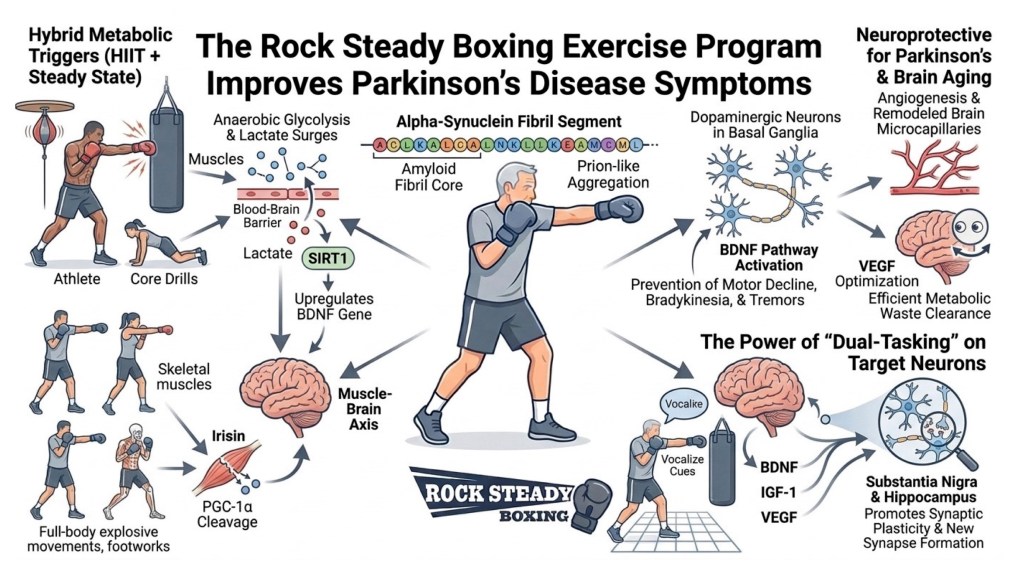
Increased Lactate and SIRT1 Activation (The HIIT Effect): Boxing is structured around intensive “rounds” of heavy bag work, speed bag drills, and core training. This interval-based design drives up anaerobic glycolysis. The resulting lactate crosses the blood-brain barrier and triggers SIRT1, which unlocks the neuroprotective BDNF gene.
Irisin and PGC-1α Cleavage: Because boxing uses full-body, explosive movements (jabs, crosses, hooks, and footwork), it demands significant use of muscle mass. This full-body movement forces skeletal muscles to release high levels of irisin and activate PGC-1α, reducing neuroinflammation and oxidative stress and further enhancing neurotrophic factor expression.
“Dual-Tasking” on Target Neurons: RSB forces simultaneous cognitive and motor tasks (e.g., throwing a specific punch combination while moving through footwork grids or shouting out words on beat). The assumption is that this type of exercise upregulates multiple growth factors (BDNF, IGF-1, and VEGF), creating new functional synapses (synaptic plasticity).
Neuroprotective Benefits for Parkinson’s and Brain Aging: The combination of exercises in RSB is also thought to protect the basal ganglia’s dopaminergic machinery and promote angiogenesis, ultimately creating a neuroprotective environment.
The illustration below summarizes the many ways RSB may be neuroprotective and, at the very least, improve quality of life for an individual with Parkinson’s.
“No matter who you are, no matter what you do, you absolutely, positively do have the power to change.” Bill Phillips
Is RSB for Everyone with Parkinson’s? Yes and No. The wonderful thing about each session is that you decide how hard to work that morning; you decide whether to give 50%, 100%, or whatever effort you can for that hour. You will certainly sweat each day. You will get down on the mat to do push-ups, sit-ups, planks, and other exercises. Even one session’s benefits outweigh the thought of sweating, getting down on the ground, and doing these group routines. While it may not be an exercise program for everyone, it provides a strong foundation for those truly interested in slowing disease progression.
Whether newly diagnosed or living with advanced Parkinson’s, I have learned that RSB supports all types of individuals with Parkinson’s. Care partners work alongside their patients, and it’s a delight to see everyone working together. Age does not matter, but it requires a willingness to use exercise to attack your Parkinson’s. Adopt the philosophy that intense exercise at least 3 days per week will undoubtedly improve your quality of life, and you may achieve some neuroprotection and, hopefully over time, neuroplasticity and improvement in some of your symptoms.
The RSB experience is unlike anything I have ever had. Yes, it is intense. No, it isn’t necessarily fun. But it keeps you coming back because you can immediately see how it will benefit you. Through intense exercise, you can fight Parkinson’s. For me, I understand why many of my new exercise partners have been attending RSB at the Riptide MMA gym for almost 10 years. In just a few months, I realized the importance of RSB and how it can reshape my disease and, hopefully, provide some traction in trying to slow its progression, even after 14 years of living with this disease.
You quickly become aware of many other aspects of RSB. Everyone there each day is there for their health; they have formed a tight group that depends on socializing with everyone present. They are a strong support group, and they are there to talk about life, but also to talk about Parkinson’s and the many difficulties presented by this disorder. Much of the interaction happens during the warm-up and before entering the gym proper, because most participants are tired by the end and need a place to sit, rest, and put their shoes back on (the gym prefers you exercise with socks or barefoot). The group also seems to know why others are absent, whether because of issues with their Parkinson’s or because they’re on vacation. The RSB group has real strength, and this camaraderie is valuable. The group also has a monthly lunch outing, and the few times I have been able to attend show the true strength of this group of individuals with Parkinson’s and their commitment to one another.
“Do not let what you cannot do interfere with what you can do.” John Wooden
Opinions About Rock Steady Boxing at Riptide MMA Gym in Bluffton/Hilton Head Island, SC: I asked others to describe their experience with Rock Steady Boxing, especially since I have only been a participant for five months. Included here are four descriptions of their experience with Rock Steady Boxing.
Comment #1 from Mark: I was diagnosed with PD in early 2023. My Neurologist recommended keeping active, moving and joining Rock Steady Boxing (RSB) as the best way to slow down the progression of my PD. I took her advice joining an RSB class nearby. It’s a 1-hr class. 10am to 11am, 5 days per week, come any days you want. There’s up to 35 PDs in the program with up to 20 attending any one day. I rarely miss a session.
“Boxing” is the core activity every day, heavy bag and speed bags, but we start out with some stretching and calisthenics. Other activities can include walking backwards; dumbbells; planks; sit-ups; pushups; ropes; squats; medicine balls; TRX pull-ups/squats, etc. Each day is a different workout.
RSB has helped me improve issues that affect most PDs like gait, strength, balance, and agility. Experts say that PDs can’t stop the loss of dopamine but through these activities, you can slow down the progression of dopamine loss.
RSB does take hard work and can be frustrating, but it is worth the effort. Most people show some improvements to their PD symptoms in a few weeks after joining. The more you put in, the more you get out. There’s an added bonus too, every day you can get free PD advice from other PDs, consider it our own support group, openly discussing our issues as well as what’s new in PD research.
Comment #2 from Terri: My journey with Parkinsons began in February of 2020. I lived full time in Indiana and visited Hilton Head for vacations and any excuse we could use to come down. After my diagnosis, I started the Rock Steady Boxing class offered at our local hospital. Their program proved to be a good thing for me, so I decided to look for a program here when we visited the island. There is no comparison between the 2 programs with the Rip Tide MMA being a superior program. They had a much less physical program and even went as far that they had us color pictures. I did it once, never again. I believe that the program and expectations here at RTMMA have been far more beneficial, and I am not sure where I would be today if I was still doing the Indiana program.
I love the program and the camaraderie here and look forward to the workout. I have an aunt who told me she is in a rut at 92 years old, but she likes the rut she’s in. I can’t say I always like what we do, but I am the best I can be for the shape I am in. I wouldn’t be near as good as I am without Rip Tide MMA.
Comment #3 from Michael: “Here I am, standing in front of a big bag, punching it, kicking it, screaming at it. I was mad. How long do I have to do this before my Parkinson’s goes away? Well, that’s not going to happen. So why am I doing this?
I can’t imagine what I would feel like today if I hadn’t participated in this program 3X/week for the last 6 years. My legs are shaky, but I can still move them. My balance is better. My hands aren’t as steady as they used to be, but I still can use them. And the built-in support system. All of these Parkinsonites, and a few non-afflicted but supportive souls who genuinely listen to your issues and help you cope, survive, and improve.
I know where I would be without Rock Steady Boxing. I am SO glad I’m not there.”
Comment #4 from Gordon “Joe” Delcambre Jr.: I was diagnosed with Parkinson’s Disease in April 2017. Almost immediately after being diagnosed, I began hearing things about some local boxing class that specialized in patients with Parkinson’s. After joining the local “Rock Steady Boxing” class in Northern Virginia, I was hooked on its benefits. The variety of exercises focused on physical health areas specific to the disease: balance, muscle strength, core, cardio, and flexibility. In 2022, my wife and I retired to the Lowcountry of South Carolina, where I found, and immediately associated with, a Mixed Martial Arts gym that offered “Rock Steady Boxing.” I am positive that my years of steady exercise have mitigated the progression of Parkinson’s. This past year I joined the Michael J. Fox Foundation government outreach efforts as an advocate to petition local, state and federal elected officials in funding more research and offer program support to those with PD. In 20 27, I will be the Fox Foundation’s lead advocate for the State of South Carolina.
“As it’s often been said, the rest of your life is the best of your life. I’m reaching for your hand now to help you reassess your attitude on living and jump into the happiest, healthiest, most productive years you will ever have.” Jack LaLanne
Closing Thoughts: Exercise is important in life with Parkinson’s. You decide how it fits into your world, and that matters most. My experience with exercise has always been positive, and it has reassured me that trying any form of exercise is better than doing nothing. My experience with RSB is like wanting to climb a mountain and shout its praise to all who can hear me. It combines a powerful set of exercise modes. It is not easy, but it has powerful potential. No doubt, time with RSB will offer your body a potent defense against Parkinson’s. I encourage everyone to find an RSB group near you. If you commit, remember you will need to attend 3 times per week to get the most from exercise.
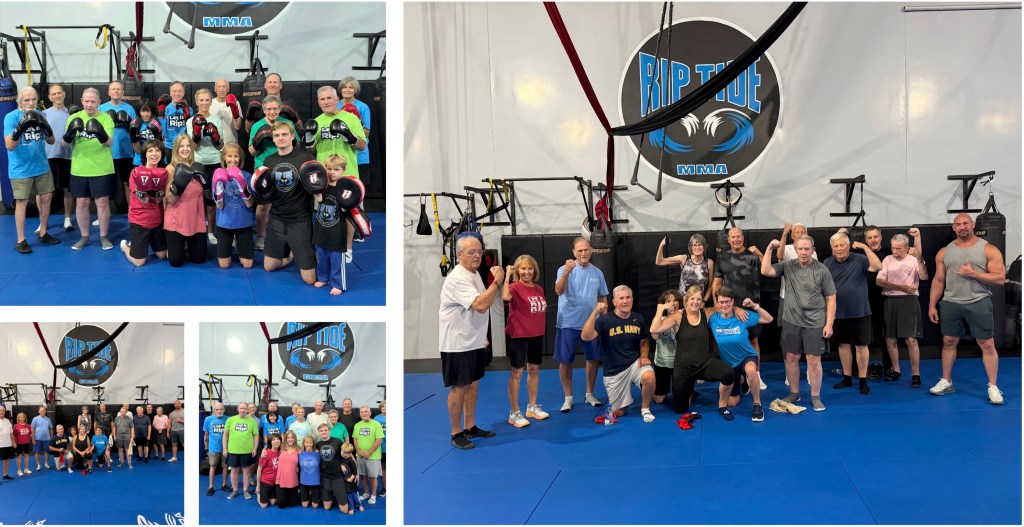
I close with some pictures of my Rock Steady exercise group in the Lowcountry of SC. They inspire me every day, especially on days when I am not so sure I really want to exercise. When I see the group and their effort, I realize this is exactly where I need to be every morning to keep fighting Parkinson’s. Rock Steady Boxing gives everyone who wants to exercise a template to push themselves each session, improve their quality of life, and even protect against the progression of their Parkinson’s.
“The critical point is that most forms of exercise are suitable for anyone with Parkinson’s. So choose an activity you enjoy, and then do it as often as you can exercise. The hopeful goal is that exercise will give you healthier lives, allowing you to negotiate a better life on your terms, not Parkinson’s.” Frank C. Church
Cover Photo credit is “Sunset on Hilton Head Island” by Frank C. Church

