“It is exercise alone that supports the spirits, and keeps the mind in vigor.” Marcus Tullius Cicero
“Your muscles know nothing. It’s your brain. Exercise is something you’ve got to do the rest of your life. It’s a lifestyle. Dying is easy. Living is a pain in the neck. You’ve got to work at it.” Jack LaLanne
Importance of Exercise in Our Lives: We are bombarded with claims about the benefits of exercise and physical activity; they’re on TV, in our reading, and everywhere on social media. Whether you have Parkinson’s or not, the emphasis is that one should exercise, and exercise a lot. Many people last did sit-ups or push-ups on the school gymnasium floor in middle school, and you have no desire to sweat from exercise as an older adult. I have seen this type of reaction to exercise in people before, when I was the “patient” for PWR! Moves instruction classes. It is everyone’s choice on how one embraces exercise.
And it is not just because of the internet’s global penetration that we are aware of the many positive health benefits of exercise. This is not a new concept. Here is a great example: a physician in 1909 highlighting one of the first centers for healing and advice from an ancient philosopher: “The use of exercise has had an important share in the treatment of disease since Hippocrates used it at the sanitarium at Cos, and Galen advocated it in words that are as true now as they were eighteen hundred years ago…” R. Tait McKenzie, M.D. (1909) in “Exercise in Education and Medicine”.
And if you do have Parkinson’s, it is even more important to be aware of the benefits of exercise. However, always remember that it is totally up to you whether you choose to exercise. My role here is just to highlight the benefits of exercise, not to sell it to you. I want you to want to exercise because the best way to succeed against Parkinson’s is to believe in yourself and in exercise as an important tool. By trusting your instincts, you can decide whether, when, what, and how you want to move forward with exercise.
“I am sick and tired of being sick and tired.” Fannie Lou Hamer
Every Day You Exercise is Day #1:
•The first day you exercise to improve your motor functions, increase your flexibility, enhance your quality of life, and reinforce your battle against Parkinson’s is day #1.
•When you return the next day, you are starting back at day #1.
•After 5 consecutive days, you reset this weekend, because on Monday you start again at day #1.
•Keep it going; exercise will enhance your life and certainly will keep you in form to defend against Parkinson’s.
•But it will not be easy, and it won’t happen overnight. Perhaps your exercise routine will improve your quality of life and your outlook on Parkinson’s.
•Every day is the same, because the “line in the sand” has been drawn and you are giving Parkinson’s an ultimatum. Keep going, and do it again tomorrow, all over again.
•Every second, minute, and hour you commit to exercise gives you newfound leverage against Parkinson’s.
•Exercise builds a foundation of confidence that will not diminish until you relinquish your exercise routine.
•Exercise builds strength, both physically and emotionally, giving you the advantage as you live each day with Parkinson’s.
•Remember, it’s not heart rate and oxygen consumption that lead the way; it’s how you feel about doing the exercise.
•Yes, the experts all say intensity matters in your exercise routines, and I am not disagreeing with them; however, just accomplishing exercise with sincerity matters even more.
•Don’t do as I say; do as you desire. But remember, tomorrow exists like today, the first day of exercise.

“There is no habit you will value so much as that of walking far without fatigue.” Thomas Jefferson
Below are 2 Studies of Exercise With Parkinson’s:
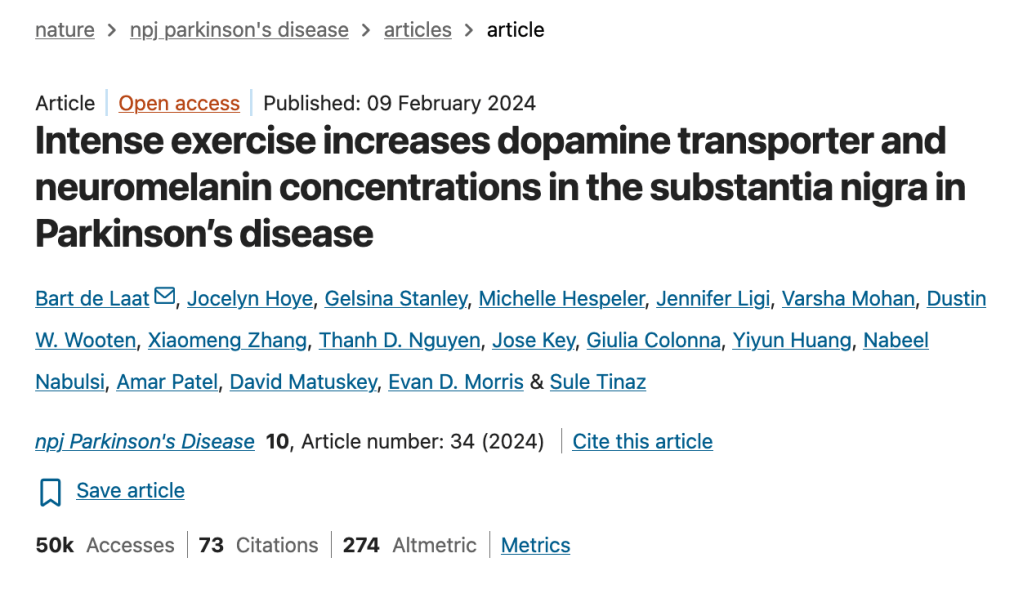
#1: Exercise can, over time, increase dopamine transporter levels and neuromelanin in the substantia nigra in patients with mild bilateral Parkinson’s. This paper is from de Laat, B.; Hoye, J.; Stanley, G.; Hespeler, M.; Ligi, J.; Mohan, V.; Wooten, D.W.; Zhang, X.; Nguyen, T.D.; Key, J. Intense exercise increases dopamine transporter and neuromelanin concentrations in the substantia nigra in Parkinson’s disease. npj Parkinson’s Disease 2024, 10, 34.
Exercise Program: Beat Parkinson’s Today combines high-intensity interval training and boxing to enhance aerobic capacity, muscle strength, endurance, gait, balance, physical function, and flexibility. Each workout is customized to suit individual needs and abilities, such as using chairs for those who find kneeling difficult. Exercises take place in small groups within a supportive environment that encourages community and adherence. A typical session begins with a 5-minute warm-up, followed by 30 minutes of exercise involving two circuits of strength, cardio, and power exercises performed twice each, with 30-second rest intervals between rounds. This is followed by 15 minutes of boxing and a 10-minute cool-down. Trainers offer personalized feedback and track class attendance to ensure participants complete the required 72 sessions.
Outcomes and Discussion: Six months of vigorous exercise led to brain changes in patients with early-to-mild Parkinson’s. They consistently saw an increase in dopamine transporter sites in the substantia nigra, while the increase in the putamen was more variable. Additionally, there was a notable rise in neuromelanin in the substantia nigra.
The dopamine transporter is critical for maintaining intracellular dopamine stores. Neuromelanin has been found to decrease substantially in the early phase of Parkinson’s. Neuromelanin appears to have a dual function: (i) it protects cells from free radicals when contained inside cells; (ii) when released from degenerating dopaminergic neurons, it may increase toxicity by triggering neuroinflammation.
The biggest weakness of this study was the absence of a control group. Furthermore, the study’s small size was another limitation. The authors suggest there may have been selection bias; however, these results are very important. This work showed in human subjects with mild Parkinson’s that intense exercise for six months increased two disease biomarkers. These results suggest that exercise is an effective neuromodulatory therapy for Parkinson’s.
#2: Neuroplasticity of brain tissue in Parkinson’s following an exercise routine: The work of Marino et al. (2023) sought to further support the hypothesis that exercise improves both motor and cognitive performance in subjects with mild or moderate disease through experience-dependent neuroplasticity. Marino, G.; Campanelli, F.; Natale, G.; De Carluccio, M.; Servillo, F.; Ferrari, E.; Gardoni, F.; Caristo, M.E.; Picconi, B.; Cardinale, A.; et al. Intensive exercise ameliorates motor and cognitive symptoms in experimental Parkinson’s disease restoring striatal synaptic plasticity. Science Advances 2023, 9, eadh1403, doi:doi:10.1126/sciadv.adh1403.

Experimental Design: To explore how exercise influences Parkinson’s, these researchers used a rat model with intrastriatal injections of α-synuclein-loaded fibers (PFFs). This approach enables observation of long-term potentiation (LTP) loss in striatal spiny projection neurons (SPNs) and displays abnormal motor and behavioral issues.
The figure here shows the overall design of the study:
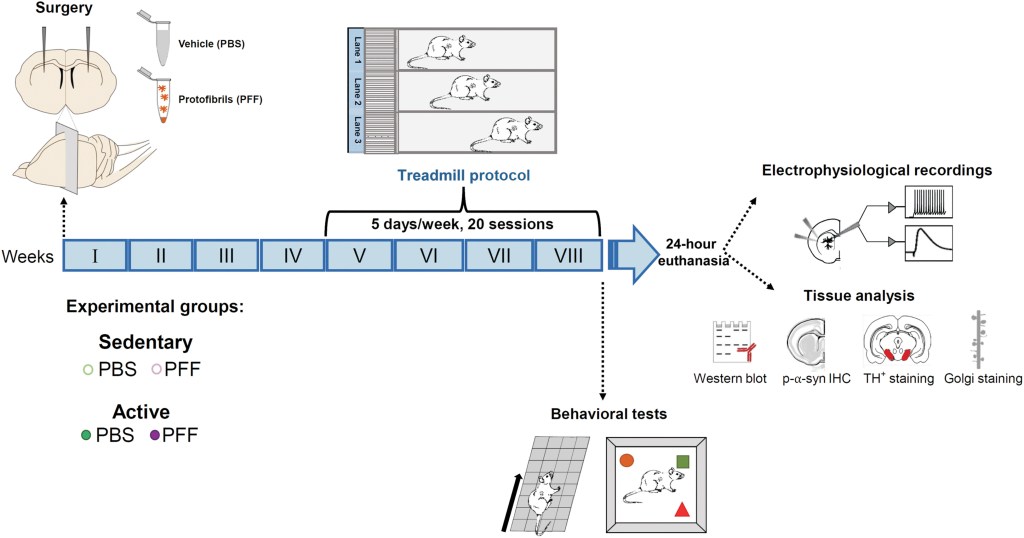
Outcomes and Discussion: To tackle this important issue, they employed a model featuring bilateral intrastriatal injections of preformed α-syn fibrils (PFFs) in rats. This experimental model enables early identification of changes, including the loss of long-term potentiation (LTP) in striatal spiny projection neurons (SPNs) and abnormal SNpc neuronal activity associated with motor and behavioral issues, prior to the onset of noticeable neuronal degeneration.
This investigation showed that intensive physical training fully restores striatal LTP in PFF-injected rats and that exercise reverses nigral α-syn aggregate accumulation and dendritic spine loss in SPNs.
These findings indicate that vigorous exercise enhances motor and cognitive functions, both of which are impaired by α-syn-PFFs. Overall, this research underscores the specific striatal synaptic and plasticity mechanisms underlying exercise’s protective role in early Parkinson’s, highlighting the significance of regular physical activity as a therapeutic approach during the disease’s initial phases.
Comments on Exercise: Today, most Movement Disorder Specialists (neurologists) consider exercise essential for managing Parkinson’s symptoms. The answers to many questions are becoming clearer, including optimal intensity, duration (time and frequency), ways to maintain long-term exercise routines, and whether there’s a ‘best’ exercise plan.
Human results align more closely with the historical animal models, showing exercise can slow disease progression in some patients, particularly in the early stages. Research on mid-stage patients indicates that exercise can delay symptoms like hand, walking, and balance issues, reduce fall risk, and enhance overall health-related quality of life. Studying advanced-stage patients remains challenging, but any exercise—usually with a care partner or trainer—is likely to lessen stiffness, boost mood, and improve quality of life. Keep faith and hope that your disorder responds positively to exercise.
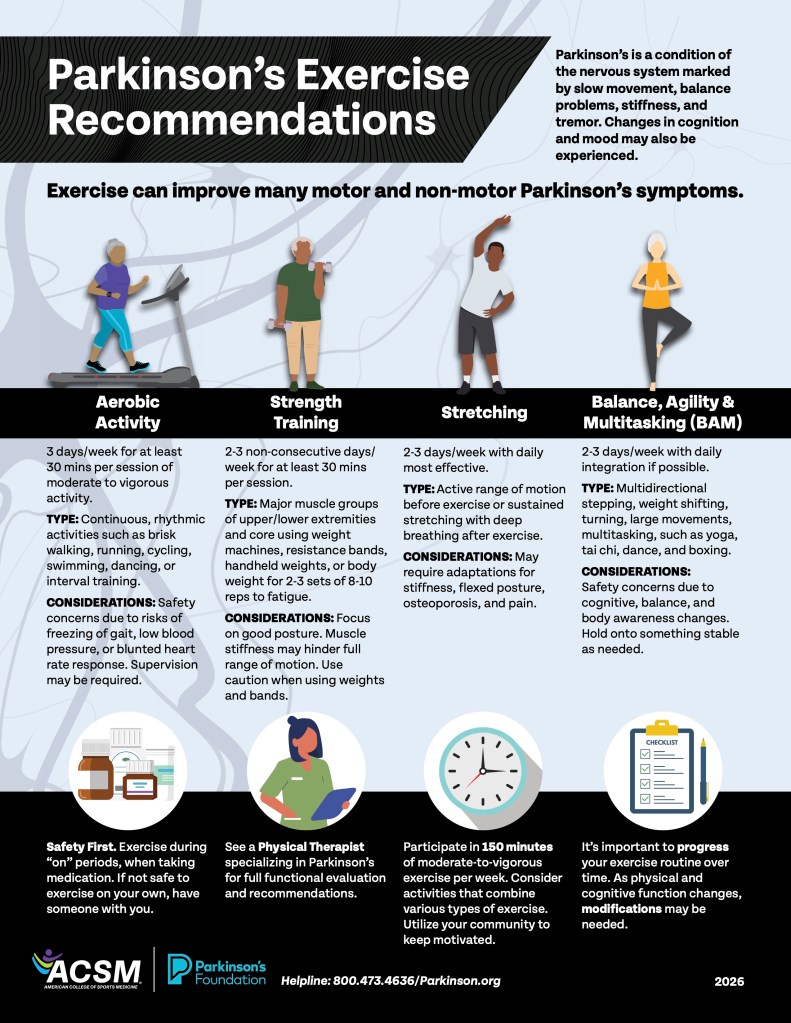
The American College of Sports Medicine (ACSM) and the Parkinson’s Foundation recommend at least 2.5 hours (150 minutes) of exercise per week, divided into four types.
My exercise suggestion is simple [and please remember, I am neither a physical therapist nor a neurologist, and this is NOT to be considered medical advice- take this exercise suggestion up with your neurologist. Your safety is of the utmost importance.].
•First, follow the chart above- if you can be vigorous and dedicated!
•Otherwise, choose exercise(s) you enjoy, stay active, and aim for 50-60 minutes of exercise and movement 4 days a week (daily is ideal if possible). Mixing aerobic exercise with weight training will work best. Pace yourself. Work into the new routine. With time, the ‘good feeling’ (benefit) from the workout will fill your lungs, heart, body, and brain. Then tomorrow, it starts all over again.
•During workouts, try to elevate your heart rate, increase your respiration, and sweat some; it might be uncomfortable initially, but think of it this way: imagine Parkinson’s is sitting in a small canoe floating on your midbrain’s lake, and sweating increases the chances of flushing it out of your body. Therefore, get moving, sweat a little, increase your heart rate a bit, and enjoy feeling better the next day.
•Stretch daily, ideally every few hours. If you sit for long periods, stand up and stretch for a minute or so every 20-30 minutes. And definitely stretch before and after any workout.
“I truly believe that the effort most people are using to handle their disorder puts them in a healthier and better lifestyle to manage their symptoms. An emerging predominant picture of Parkinson’s today is a person striving to live strongly.” Frank C. Church
My Inspirations for This Blog Post:
#1- My friend Amy Lindberg (a former Navy Captain and current Rock Steady Boxing leader/instructor in NC) has been telling me for a while how beneficial Rock Steady Boxing is. I finally took her advice last month and have been working out with the “Riptide MMA Rock Steady Boxing group of Bluffton/Hilton Head Island” [they meet Mon-Thurs at 10 AM, with Fri as an optional workout day (thus, golf is on hold for a while)]. The group was founded and is led by John Juarez.
Not only is Amy a role model for me, but I also admire her courage, words, and commitment to speaking the truth about Parkinson’s. She is a tireless warrior against Parkinson’s (her story is partly told here: click here).
#2 – The Parkinson’s participants and their Care Partners at Rock Steady Boxing are truly my new inspiration. This is not a small group. I venture to guess that 20-30 show up daily to exercise. And yes, it is quite rigorous. Everyone participates, exercising as one with the group, sharing sweat and voices, walking/running and lifting, stretching, and boxing. When will those push-ups and planks ever stop? I do admire everyone’s fortitude and commitment to show up almost every day for their own battle against Parkinson’s. My description of Rock Steady Boxing will follow later this summer. But now I look forward to seeing everyone during tomorrow’s class, starting back on day #1.