
“It is no achievement to walk a tightrope laid flat on the floor.” Ray Kroc
“Being on the tightrope is living; everything else is waiting.” Karl Wallenda
Introduction: Life in the presence of Parkinson’s is not easy because you are always managing health, energy levels, drug therapy timed with meals, and active symptom management; this feels much like walking a tightrope. It feels like a constant balancing act, where a shift in either direction can throw things off. And when that happens, everything collapses on you, and you fall off the tightrope. Here are a few examples.
“It is really a tightrope sort of thing, living.” Joy Hester
•Each day starts with timing Crexont (carbidopa/levodopa) around the day’s events, including my eating schedule:
Typically, my weekday is centered around Rock Steady Boxing class from 10:00 AM-11:00 AM. This means I carefully time my first dose of Crexont so I’m in a good place for dopamine-readiness to exercise. Therefore, I routinely take my first dose of Crexont around 7:00 AM, so 3 hr later, at 10:00 AM, I am primed and ready to go. This ‘strategy’ has worked well with boxing because by 11:30 AM, I have maxed out my dopamine stores, and I still have enough energy to drive home, eat lunch, relax, and keep the day going. This is walking the tightrope as planned, no slipping.
By contrast, it is day 2 of a Bermuda vacation, 10:30 AM, and I am still waiting for the first dose of Crexont (taken at 8:15 AM) to kick in. I can barely move around the room. Something isn’t synchronized this morning; the tightrope path is slippery, and I am likely to fall off. I took a separate dose of standard carbidopa/levodopa tablet (sublingually), started feeling “on,” and began the day back on the tightrope.
“Step with care and great tact. And remember life’s a great balancing act.” Dr. Seuss
•Taking advantage of special services at the airport:
We have been fortunate to travel several times per year, more than I ever expected, retired and with Parkinson’s. A helpful step has been at airports. For several years, I have always forged ahead before general boarding begins at the gate and told the attendant: “I have Parkinson’s disease, and it really helps me to have a few extra moments to get settled in my (our) seat(s). Is it okay to board early?” It has never failed, and it is a very truthful comment. Relieving the stress of getting situated on an always-crowded commercial flight keeps the tightrope taut.
Airlines also offer free wheelchair service (transportation) from the counter to the gate upon request. I had never used this service before. On our last trip to Vermont and Maine, I had a total freeze event, which I still haven’t explained to my satisfaction. To prevent a recurrence on this trip, I was escorted by wheelchair from Terminal E Gate 45 to Terminal A Gate 3 (about as far as one can go at the large Charlotte, NC airport), and it was smooth and wonderfully quick.
Upon arriving in Bermuda, another wheelchair driver escorted us to Customs, and we entered Bermuda (on the citizens’ side) in only ~5 min. She then took us to baggage claim, and I said thank you. A decision that kept the tightrope working better than anticipated. A simpler solution, yes; I had to swallow some of my stubborn streak, but I stayed on the tightrope.
“The balancing act is challenging at times.” Jeremy Jones
•Managing the fatigue following dopamine-consumption after a Rock Steady Boxing workout (I plan to focus an upcoming article on “The Dopamine Taper” fully dedicated to fatigue in Parkinson’s. It should be posted sometime the week of November 22-27):
Many days in the past 6 months of actively participating in Rock Steady Boxing have left me fully ‘wiped out’ and fatigued. Although I definitely feel like I am getting into a much better physical condition, it is not like it was before Parkinson’s. I definitely remember the times when I would get my second or third ‘wind’ during strenuous exercise. Today, there may be a hint of a second wind; however, my heart is more likely just catching up with the rest of my body. So after many years of Parkinson’s, my body has some reserve, but not what it was earlier in life. Now, some days after Rock Steady Boxing, fatigue sets in, and it feels like the tightrope has just collapsed.
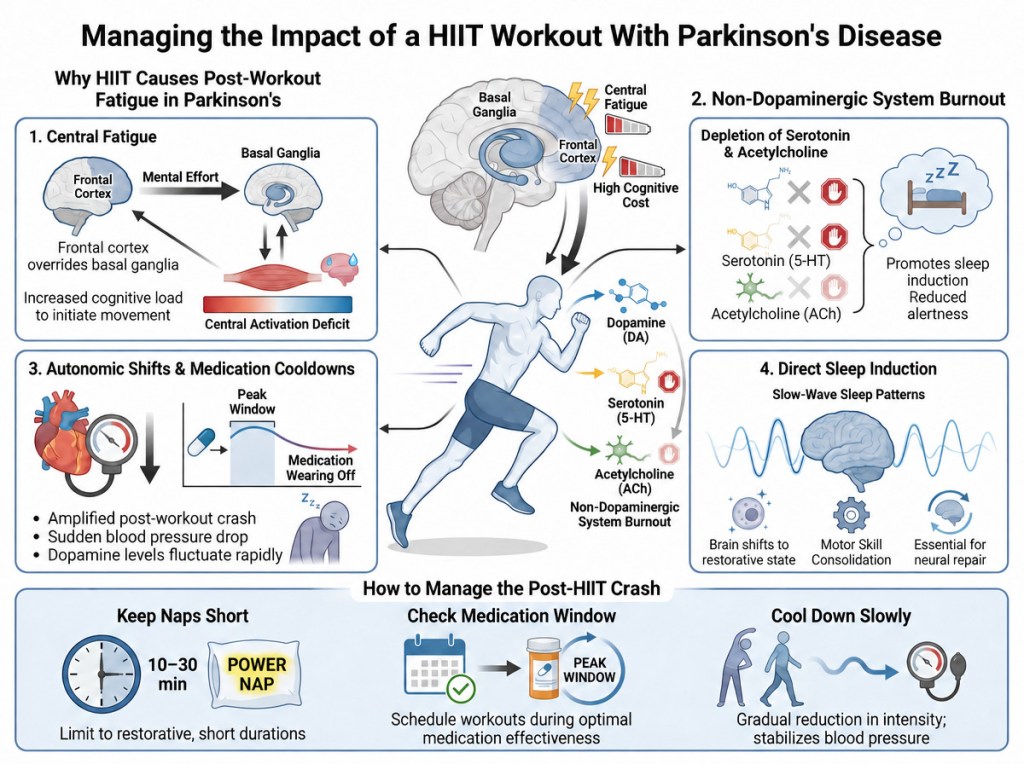
The illustration above highlights some of the responses you encounter when trying to manage an intense workout like Rock Steady Boxing (well, I think it’s intense). Imagine your car’s warning light has been telling you for a while that the gas tank is almost empty. Consider this your current dopamine level. Furthermore, serotonin and acetylcholine are reduced. You are exhibiting central fatigue where it requires effort to move. Likely, your medication is wearing off.
The best way to manage this fatigue is to take a power nap, check your medication, and slowly cool down to help reverse a potential drop in blood pressure after exercise. Recharging your internal stores is definitely necessary; a nap can be restorative. This is more like taking a break from walking the tightrope, because fatigue in Parkinson’s is real, whether it’s induced by strenuous exercise or not. I feel it is a small price to pay for the overall benefit I get from Rock Steady Boxing. It becomes an issue, and it turns into a problem of staying on the tightrope, when I end up taking a nap for several hours (which is described in the next example).
“I’ve got forward momentum. There’s no virtue in it. It’s just a balancing act. I don’t dare stop.” Lois McMaster Bujold
•Maintaining my balance on the tightrope by managing my sleep disorder(s), which are an ever present battle:
I have developed a routine that I have used for the past year to manage my sleep. For me, it is more related to getting ‘quality’ sleep rather than simply getting ‘quantity’ of sleep. I rarely have a problem falling asleep at night; usually, I am asleep in 5 minutes. My problem is staying asleep. Dealing with the REM sleep disorder portion is not really something I try to manage; it happens only occasionally (maybe once or twice every few months).
I solved my need to get up once or twice a night from a leaky bladder. One little pill has solved this mystery (and I am most grateful to my urologist for solving it).
The supplements I take every evening are mostly glycine, magnesium threonate, and melatonin (usually a very low dose, 600 micrograms). I usually spend 45-60 minutes relaxing, trying to turn off my brain by listening to music or even a late-night news program. Since I have no problems falling asleep, I am not concerned about the TV being on. My goal is to get 6-7 ‘good’ hours of sleep each night.
When I get enough sleep, my balance is better when dealing with the tightrope, my energy is better, and my Parkinson’s medication seems more efficient and lasts longer. However, not achieving these sleep goals leaves me cranky, a feeling that I have forgotten to take my medication because it can’t seem to be working as well as normal, and my balancing act on the tightrope is certainly challenged. And it leads to much longer naps following boxing due to the accumulated sleep deprivation that can occur.
“Life is a tightrope between two errors: generalizing the wrong particular and particularizing the wrong general.” Nassim Nicholas Taleb
•The consequences of eating too large of a meal definitely challenges the tightrope: I have written about this before: consuming a large meal slows our digestive tract even further than Parkinson’s already does (“Understanding how Parkinson’s Affects Food Digestion ” click here). This ‘slowing down’ process can wreak havoc with the metabolism of the next dose of carbidopa/levodopa. And it doesn’t matter whether this is a protein-laden meal or not; the larger the meal, the longer it takes to clear. Thus, your balance on the tightrope is off, and for me, it often means an immediate nap or a freezing event where it’s harder to move around. And if the big meal is breakfast, your balancing act on the tightrope may be challenged for most of the day.
“As we look deeply within, we understand our perfect balance. There is no fear of the cycle of birth, life and death. For when you stand in the present moment, you are timeless.” Rodney Yee
Conclusions: Living with Parkinson’s is demanding! Living with Parkinson’s is challenging! Portraying some of the issues that occur in Parkinson’s as walking on a tightrope does not mean I can actually walk on a tightrope (and wear tights too, haha!). No, I envision life with Parkinson’s as a “balancing act.” Some days, you can anticipate everything that needs to happen for a good, well-functioning day, and you move smoothly on your tightrope. However, there are times when, no matter the attempt or attention to your Parkinson’s, your balance is off, and you tumble off the tightrope. May the life you live always keep you mastering your own personal Parkinson’s tightrope.
“Sundown- When the sun must make peace with the moon and for a few brief moments, the two touch in mutual friendship and respect. Perfect balance between the light and dark. A time for reflection and for preparation.” Sherrilyn Kenyon
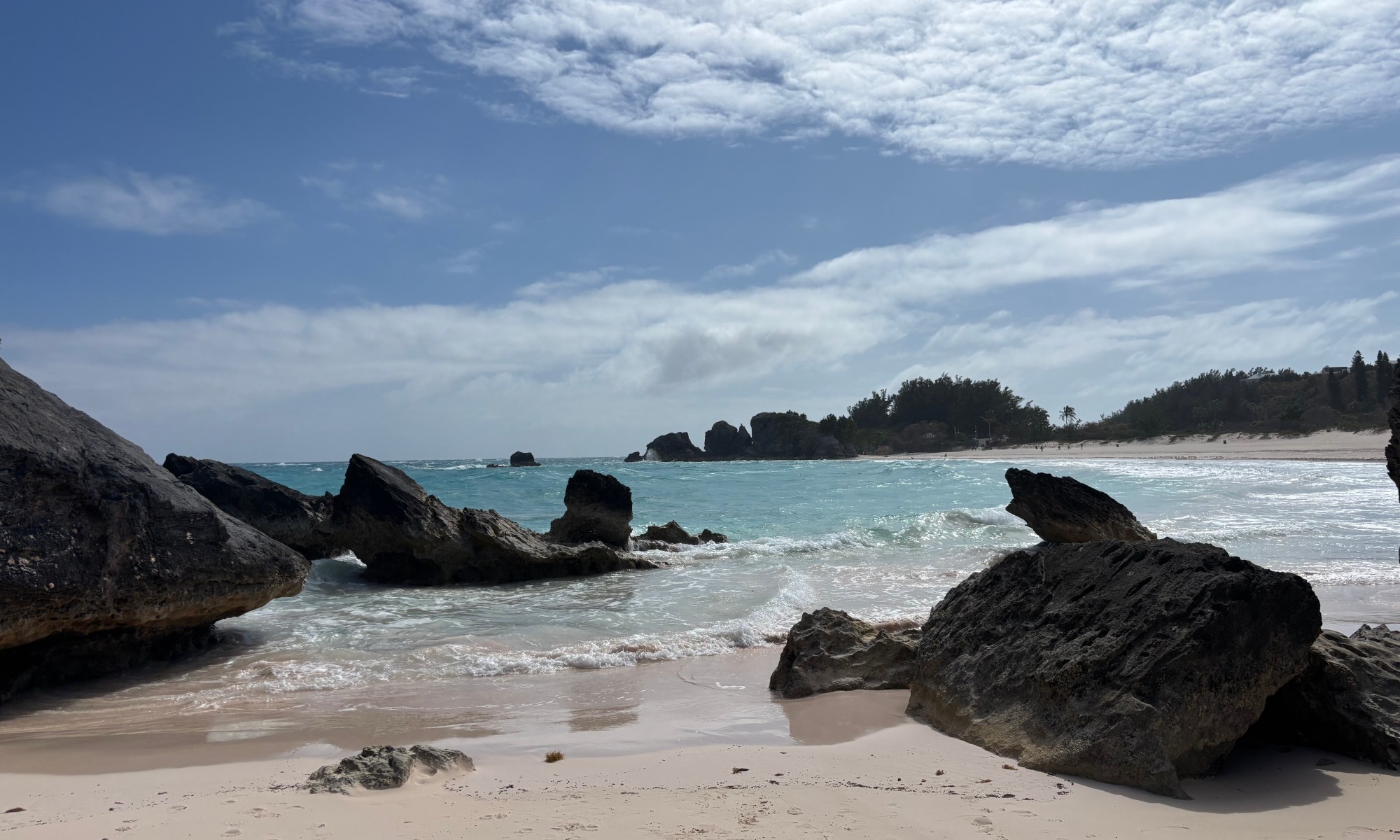
Cover photo image of Bermuda from Frank C. Church

