

“It is not by muscle, speed, or physical dexterity that great things are achieved, but by reflection, force of character, and judgment.” Marcus Tullius Cicero
“Life yields only to the conqueror. Never accept what can be gained by giving in. You will be living off stolen goods, and your muscles will atrophy.” Dag Hammarskjold
Introduction: Are you familiar with the Cardinal symptoms of Parkinson’s by now? Here they are again: bradykinesia (slowness of movement), tremor (trembling in hands, arms, legs, jaw, and face), and muscle rigidity (stiffness of the limbs and trunk) along with impaired gait and posture.
Where is the topic going? Along with many of you, I’m a weekend warrior, always trying to improve my golf game and maintain my health with Parkinson’s. And as such, I end up with a lot of sports-related injuries. I do know that several of you have written about muscle pulls and strains and constant pain from this process. Could one of the supplements we are taking be causing the increased muscle stiffness? Could the susceptible muscle strain and discomfort be caused by anything related to Parkinson’s? What is causing the residual pain from exercising?
Remembering that I am neither a physician nor a sports physiologist, I return to the original Cardinal signs. In my opinion, most of the sports injuries I have suffered over the past few years are directly related to my ever-present muscle rigidity or stiffness. Today’s blog post is centered around three publications given below.
“Commitment is a muscle. The more you use it, the stronger it gets.” Chalene Johnson”
Passive Muscle Stiffness in Exercise-induced Muscle Damage (EIMD): I sometimes have trouble wearing a sweater over a long-sleeve shirt. Is that from the 18 holes of golf I played yesterday? Doubtful because it happens whether or not I play golf. Simply put, I think it is the muscle rigidity or stiffness I have from Parkinson’s. It seems that I have this background rigidity no matter what drugs I take, no matter what exercise or therapy routine I have or am being treated for. For example, recently, I have been going to a Physical Therapist to loosen the stiffness in my hip joint and strengthen the surrounding musculature. I completed a hard 1-hour session of stretching and exercising, and the PT evaluated my hip flexibility. While it was pretty good for me, it still shows signs of residual stiffness.
There is an evilness to Parkinson’s, a sinister attack on our bodies that makes our muscles stiff and rigid. Parkinson’s wants you to be lazy and passive, and all too frequently, we comply. Start each day by stretching before you even get out of bed. Do not sit for more than 20 minutes at a time; get up, get moving, stretch some, and then return to the chair. And the list goes on and on. Here’s the first paper to discuss.
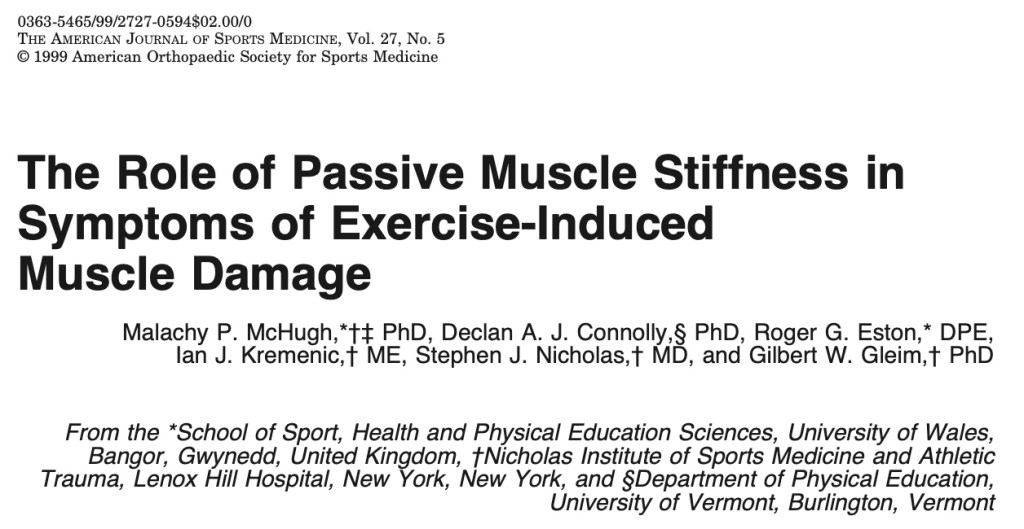
There is a lot of literature on this topic; however, the issue is understanding the relationship between flexibility and muscle strain/injury. McHugh et al. (McHugh, Malachy P., Declan AJ Connolly, Roger G. Eston, Ian J. Kremenic, Stephen J. Nicholas, and Gilbert W. Gleim. “The role of passive muscle stiffness in symptoms of exercise-induced muscle damage.” The American journal of sports medicine 27, no. 5 (1999): 594-599), nicely presented such a study.
Their study revealed an association between flexibility and muscle injury and provided experimental proof of this relationship. In other words, those of us with Parkinson’s and a constant measure of muscle rigidity/stiffness are just more prone to muscle damage after exercise.
“Great ideas originate in the muscles.” Thomas A. Edison
Exercise-induced Hypoalgesia is Functional in Parkinson’s Disease: In general, exercise promotes an intermediate short-term reduction in pain sensitivity. This is known as exercise-induced hypoalgesia (EIH). However, some disease states with chronic pain conditions (an example would be fibromyalgia) have just the opposite effect following exercise. A person with fibromyalgia has a reaction to exercise, which leads to an immediate increase in pain sensitivity. Thus, they experience the opposite or exercise-induced hyperalgesia.
The study highlighted here evaluated whether or not people-with-Parkinson’s (PwP) would have a hypo- or hyperalgesia response following exercise.

This study from Nguy et al. (Nguy, Vanessa, Benjamin K. Barry, Niamh Moloney, Leanne M. Hassett, Colleen G. Canning, Simon JG Lewis, and Natalie E. Allen. “Exercise‐induced hypoalgesia is present in people with Parkinson’s disease: Two observational cross‐sectional studies.” European Journal of Pain 23, no. 7 (2019): 1329-1339), was a fascinating read.
Their results showed that PwP had an exercise-induced hypoalgesic response following exercise, similar to the control group. Interestingly, the reaction of the PwP to exercise did not vary between mild and moderate exercise. As we all know, exercise is an essential aspect of our lives for PwP. Although from a small study of 30 participants, the results presented here show that PwP can exercise without an immediate increase in pain sensitivity.
“Practice puts brains in your muscles.” Sam Snead
Using Curcumin for Exercise-induced Muscle Damage: While researching this topic, I came across this review and thought it was interesting.

Nanavati et al. (Nanavati, K., K. Rutherfurd-Markwick, S. J. Lee, N. C. Bishop, and A. Ali. “Effect of curcumin supplementation on exercise-induced muscle damage: a narrative review.” European Journal of Nutrition 61, no. 8 (2022): 3835-3855) did a thorough review of the usefulness of using curcumin (a polyphenol from turmeric) to circumvent exercise-induced muscle damage. Curcumin is known to have anti-inflammatory and antioxidant activity; thus, it has been studied in many chronic inflammatory conditions. They found that taking curcumin (90-5000 mg/day) reduced muscle damage when consumed close to exercise. Curcumin decreased pain perception, reduced pro-inflammatory cytokines, and improved muscle performance.
The issues are all about what type of curcumin one takes for supplementation. Curcumin has a natural lack of bioavailability due to its relative insolubleness in water and poor uptake in the intestinal tract. I would carefully read this paper about the various available forms of curcumin and that eliminating EIMD is a challenge. I take enough supplements. Several are polyphenols; thus, I am not proceeding with using curcumin to address my stiffness and muscle injuries.
“Life yields only to the conqueror.” Dag Hammarskjold
Summary: Recently, my mind has been focused on the role of exercise in Parkinson‘s. These three papers, taken together, offer some global thoughts about muscle stiffness and potential pain associated with Parkinson’s. There are always more questions than answers regarding Parkinson’s. And there are many excellent articles to read and absorb knowledge from in the literature. Keep exercising, stay positive and hopeful; winter’s hard edge is weakening and is on the way out (well, it feels that way in the southernmost region of South Carolina).
“Science explained people, but could not understand them. After long centuries among the bones and muscles it might be advancing to knowledge of the nerves, but this would never give understanding” E. M. Forster


Interesting. I am poking around about how Taurine depletion or deficits affect muscles and Calcium processing a la contractions etc. in PD. One related controversy is that intensive exercise MAY bring on PD symptoms such as tremors etc. Another controversy is how dopamine (levadopa) interacts with Taurine levels…possibly the more dopamine you get for PD, the lower your level of Taurine becomes. Intersting.
LikeLike
Eugene,
thanks for your note. Taurine is an interesting substance, I am not familiar with what you mention, but I am trying to imagine how levodopa interacts with taurine itself to lower its concentation. I wrote a blog post several year on taurine in Parkinson’s: https://journeywithparkinsons.com/2018/04/05/neuroprotection-with-taurine-in-a-parkinsons-model-system/. . Since that blog post, I take taurine daily. Best wishes, Frank
LikeLike
To our ‘Tribe’: About 4 weeks after my PD Dr added 1200mg of entacapone to my regiment, I began to experience moderate to severe pain in my hamstrings ( exclusively). On more than one occasion, I have felt one of the muscle bands “roll” as I bent over. The pain when this happens is excruciating. I see my Dr in 2 weeks so I am seeking any input others, and of course you Frank may have. I did have one mostly stiffness and pain free day Sunday. I rowed for 10 minutes then did recumbent bike for 20 mins followed by 30 minutes of stretching. The following day I was back to the new normal of tightness and pain.
LikeLike
Tommy, when I was using Entacapone, my Neurologist was very specific, take 200 mg tablet 3 times/day (I take levodopa/carbidopa five times/day, so for the 1st, 3,rd, and 5th dose I would 1 200 mg tablet of entacapone. I had to quit b/c I developed chronic diarrhea from it. But it definitely worked, I was not taking my 5th dose of levodopa/carbidopa. Next, I tried 50 mg capsule of Ongentys (once per day at night), and after 2 months, Susan asked me to stop b/c she thought my symptoms were advancing So I quit, and everytehing returned to normal. COMT inhibitors are powerful drugs in their own right, I will just get by in their absence. If you really are taking 1200 mg/day of entacapone, I would question why you need so much. Its action is quite good at prolonging levodopa in your peripheral tissues, so maybe the amount of levodopa you have in your bloodstream is affecting your muscle tone? I don’t have an answer, sorry. Frank
LikeLike