

“I encourage all of you to seek out teachers and mentors that challenge you to think for yourself and guide you to find your own voice.” Renee Olstead
“The delicate balance of mentoring someone is not creating them in your own image, but giving them the opportunity to create themselves.” Steven Spielberg
The News: It was a short text from my good friend Mark, sent to several of us who had the same graduate school advisor, were part of other lab groups, and we had become and stayed friends all of these years (dating back to the late 1970s): “I just found out that Harold died last Monday, Oct 6! I’m shocked! No details.” A quick internet search for his name revealed the following:


When >8,000 people die every day in the USA (click here), how does one individual matter? It matters because every person has lived their life, had interactions with others, and has left their impact or influence on them. This is a story about Dr. Harold E. Swaisgood, husband, father, scientist, mentor, and friend.
“A good mentor offers directions and driving tips from the back seat. You still have to drive the car.” Michael Johnson
Who was Harold E. Swaisgood, PhD? His most recent LinkedIn title, as of February 2001, reads: “William Neal Reynolds Distinguished Professor Emeritus, NC State University Department of Food, Bioprocessing and Nutrition Sciences, Feb 2001 – Present · 24 yrs 9 mos.” This description tells us two things: Harold retired in February 2001, and his named William Neal Reynolds professorship was a significant honor. “The William Neal Reynolds professorship is one of the college’s highest honors, created to recognize outstanding scholars, leaders, teachers, and mentors.” What this description does not say is what he meant to those he trained, to those he counseled, and to those he cared about.
•Dr. Swaisgood came to North Carolina State University in 1964 after finishing his PhD in Biochemistry at Michigan State University.
•He was a biophysical chemist who studied milk proteins.
•He was well respected and a leader in the field of dairy science; he was a world leader in the area of the biotechnology of immobilized enzymes, and he spent his career devoted to a better quality of food by understanding the molecular details of the many proteins we consume daily.
•He was not a boisterous person, and in his own way, he was very personable.
•He studied and collaborated on many different types of research areas; thus, he wore many hats in his time.
•He was not a forceful leader; he led by example and expertly guided us through the process.
•He accomplished a lot in his academic career, yet he remained humbled and full of gratitude at all times.
•His lab group was comprised of people from all corners of the world.
•He was incredibly bright, probably one of the most intelligent persons I have ever known, and he was able to use this intelligence for many years effectively.
•He was a kind person, always supportive, and on your side.
“Mentoring is a brain to pick, an ear to listen, and a push in the right direction.” John Crawford Crosby
My PhD, under the Direction of Harold E. Swaisgood: Everyone who worked with Dr. Swaisgood (his laboratory nickname was “Chief”) will have their own thoughts, stories, and memories to share, and I hope to hear many of them in the near future.
I was accepted into Graduate School at North Carolina State University and joined Harold’s laboratory in August of 1978. I completed my B.S. at Louisiana State University in 1975. Then I became a teaching tennis professional. At the same time, I spent several years working on my M.S. degree at LSU. I arrived in Raleigh, NC, and NC State, convinced that this was a good step forward. Still, I was absolutely clueless about graduate school and was searching for a compass to help guide me through school and life.
Guidance, advice, and knowledge came from two different directions. First, my dear friends and fellow graduate school colleagues (most notably, Mark and Mary S., Mary Ellen S., Cathy D., Frank E., and Alice H.; and many others could be named here, but these were most notable), their friendship and advice gave me a bright light to navigate through the dark tunnel of a PhD program. And second, Dr. Swaisgood, his timely advice was invaluable throughout my PhD. His lifelong mentorship and his friendship guided me through my own academic career from my postdoctoral fellowship, through to my academic appointments at the University of North Carolina at Chapel Hill, my retirement due to Parkinson’s, and finally, my journey with Parkinson’s disease. Although I could write thousands of words about the importance (and our adventures together) of my friends mentioned above, I need to summarize some of the things I learned while working in Harold’s laboratory.
“A mentor must always guide, never push. It was my job to listen to them, offer my perspective, and encourage them to pursue the ideals they believed to be true.” John Wooden
Six Things I Learned from my 40+ Years of Mentorship from Dr. Swaisgood: I began the Acknowledgments in my Doctoral Dissertation (August 1982) by thanking Harold: “I would like to express my sincere appreciation to Dr. Harold E. Swaisgood, my advisor and friend, for his guidance and encouragement throughout the course of this research, and for giving me his thoughtful insight into the fine art of techniques in physical biochemistry.” What I would like to present here in October 2025 is a description of how his mentoring influenced my life and academic career.
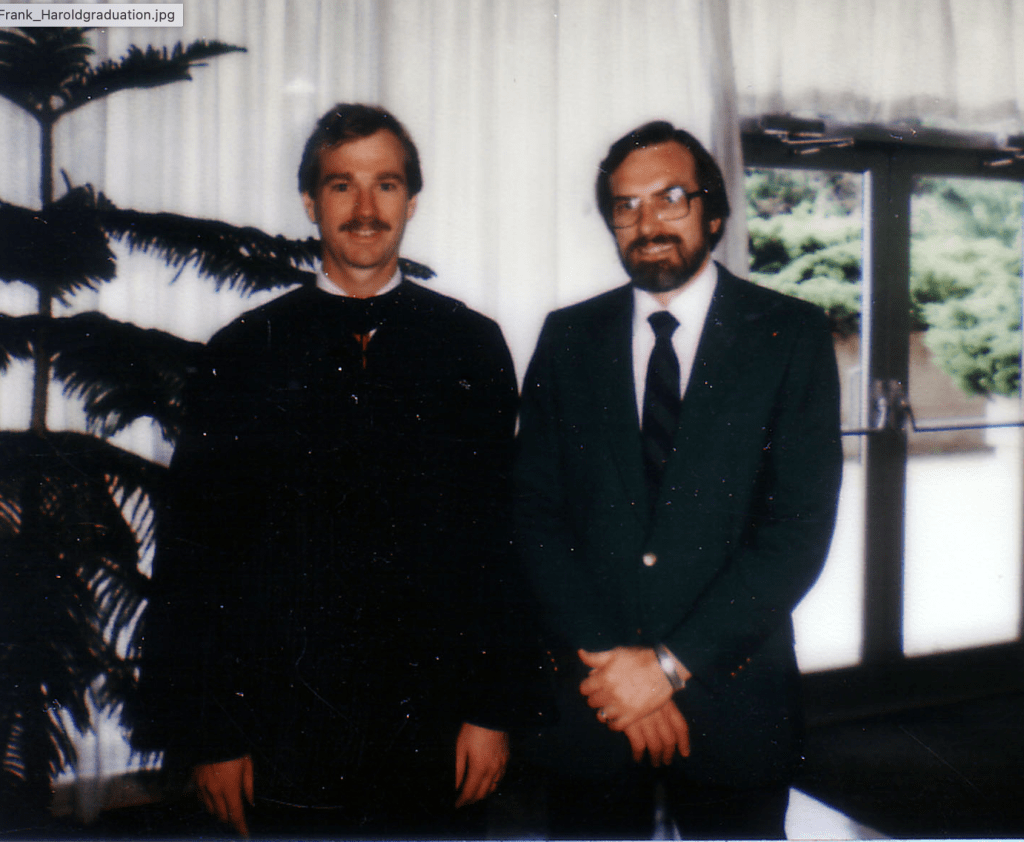
- Strive for independence, but always remember your support system is your lab group: Harold always let me work on my own (however, he also expected it). My hands did the work of the experiments I designed. I leaned on the lab group to help solve the issue of why something was not working as planned. And I would seek Harold’s advice on creating new paths to solve my problems. The lab group did not need his advice on fixing the pH meter or the amino acid analyzer; we took care of those issues. I needed his help to derive another equation to solve a science puzzle or to help decide which path to take to answer the problem successfully.
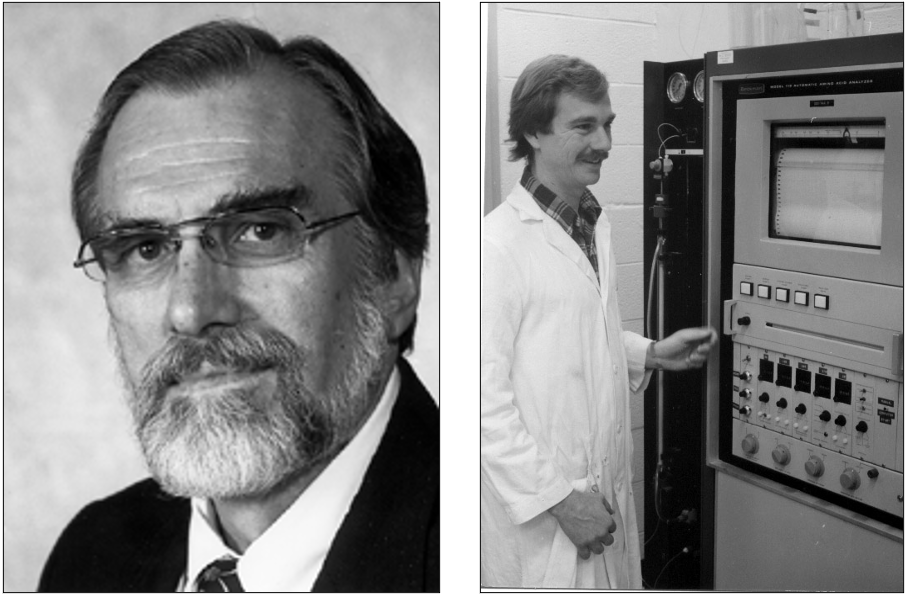
- Ask the best questions to answer the goals of the project: Today, all you hear about is adding protein to your diet, from Grape-Nut cereal to Starbucks coffee. All these ads state the amount of protein you’re consuming. Still, they never mention the nutritional quality of this protein. My dissertation project aimed to develop a system for measuring protein quality. Proteins are made from amino acids, and proteases/peptidases are enzymes that function to break down proteins into peptides and amino acids. Therefore, more than four decades ago, we asked and answered questions that allowed me to develop an experimental reactor for assessing the functionality of proteins. As I reflect on this science, my interests became focused on human diseases after my PhD. Nevertheless, I continued to work with proteases for the remainder of my research career.
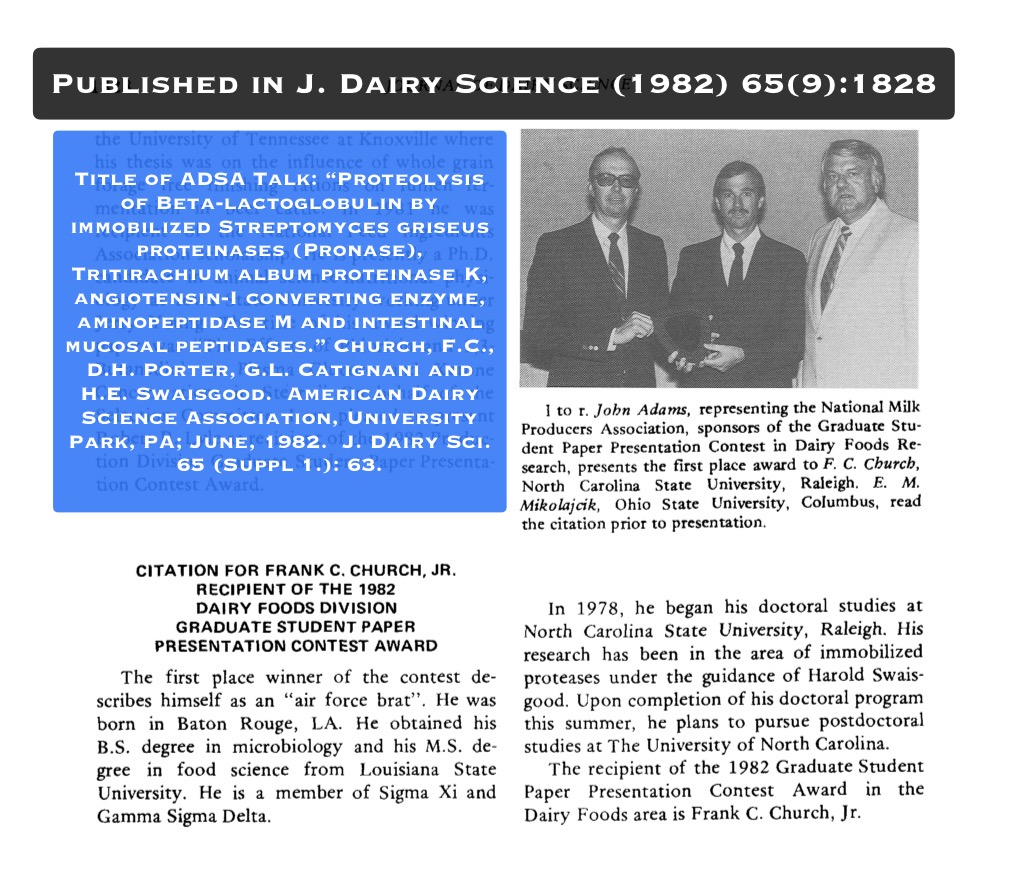
- Simple is better than complex: It is easy to complicate things. And finding the most straightforward answer or approach usually works. I had submitted an Abstract for presentation at the American Dairy Science Association annual meeting. My Abstract had been accepted for an oral presentation. Please be reminded that this was long before laptop computers and programs like Microsoft PowerPoint or Adobe Photoshop. I wanted to use a new kind of slide preparation that was in color and full of pizzazz. Harold proposed that he use his camera and take black-and-white photos to create slides. He argued that I had a really nice science story to tell, and the quality of my talk and the strength of my story were what I needed to focus on. And the fancy color slides would not make a difference to the quality of your science. Harold was right; I received the award for the best presentation with my straightforward black-and-white slides.
- Imagination matters: Amino acid composition analysis is a classical protein analysis method. However, it is an expensive machine that is not routinely found in most laboratories, and it takes 1-2 days to process and generate results. My laboratory had developed a fluorogenic assay using o-phthalaldehyde (OPA) that measured the release of hydrolyzed amino acids. However, fluorimeters are not common, and some of the OPA-amino acid adducts were unstable. Thus, I imagined if there was a simpler, faster, and more convenient test. What about measuring OPA-amino acid adducts in a spectrophotometer? The paper entitled Church, F.C., Swaisgood, H.E., Porter, D.H., and G.L. Catignani (1983). Spectrophotometric assay using o-phthalaldehyde for determination of proteolysis in milk and isolated milk proteins. The Journal of Dairy Science, 66(6), pp. 1219-1227, has been cited almost 2,000 times since 1983, with the most recent citation occurring as recently as this month (85 times in 2025). Turning imagination into reality made a difference with this work.
- Intelligence is only part of the equation to success: When I joined the lab group, Dr. Swaisgood’s research was focused on many topics: immobilized enzyme technology, the enzymatic mechanism of sulfhydrl oxidase, the compositional quality of protein using proteolysis, the rheology of ultra-high temperature milk, examination of casein micelle structure, determining the enzymatic mechanism of immobilized malate dehydrogenase, and tissue distribution of mammalian sulfhydryl oxidase. Students, postdoctoral fellows, and visiting faculty came from all around the world to train in the Swaisgood laboratory. The science brought us there, but he captured our attention, and we wanted to stay there. Indeed, intelligence plays a crucial role in navigating the challenges of both basic and applied research successfully. However, there is something else that enables one to successfully manage a laboratory with numerous projects and an equally diverse group of personalities. Looking back, it was as if I arrived in his laboratory as a neophyte wearing diapers, and I left his lab as a well-trained and knowledgeable adult scientist ready to plan my own research projects and manage the issues of a diverse and hard-working laboratory research group.
- Support and caring do not end after you leave the laboratory: Harold did a fantastic job of staying in contact with all of us by email. He frequently described how he and the love of his life, his wife Janet (who he lost in August 2023), would visit the San Diego zoo and Safari Park (he retired in San Diego, CA, to be near his sons). And he would always invite us to visit them in San Diego. I was able to spend an afternoon with Harold and Janet in San Diego (June 2015). He sent me the following thought when I retired in 2022: “I’ve read many of your blogs. I’ve been very impressed by them. I wish you the best in retirement. I know you will enjoy playing more golf and I hope you will enjoy time on the beach.“
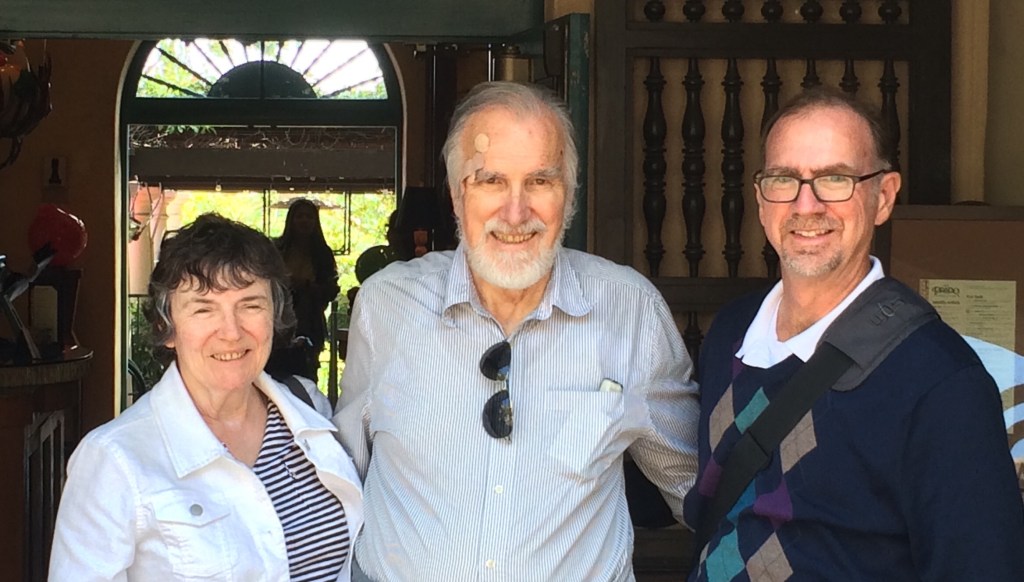
Harold emailed me this thought a while ago: “I have been following your blog. Life presents many challenges; we don’t know what or when they will come. I feel very fortunate to have survived my most serious one in 2001. I feel great empathy for you and the tremendous challenge you are facing. I greatly admire your determination and attitude. Staying connected and helping others facing the same difficulties is very rewarding.” The last conversation I had with Harold was a Zoom visit with Mark S. and me in August 2024.
“A mentor is someone who sees more talent and ability within you than you see in yourself, and helps bring it out of you.” Bob Proctor
Closing Thoughts: I was truly blessed to have worked in Harold Swaisgood’s laboratory. He gave me the tools to think like a scientist and taught me how to be one. His laboratory group, in fact, the entire group of Food Science people in Schaub Hall and Biochemistry people in Polk Hall at NC State, gave me many life lessons. Their lasting friendships have provided the foundation for much of how I have led my life. Everyone needs a mentor at various times in their life because they provide guidance, help you discover yourself, and care for you in their own special way. Dr. Harold E. Swaisgood was my mentor and dear friend for many years. Rest in peace.
“What you want in a mentor is someone who truly cares for you and who will look after your interests and not just their own. When you do come across the right person to mentor you, start by showing them that the time they spend with you is worthwhile.” Vivek Wadhwa
Publications from my Dissertation research:
•Church, F.C., G.L. Catignani and H.E. Swaisgood (1981) Hydrolysis of milk proteins by immobilized Streptomyces griseus Pronase. J. Dairy Sci. 64: 724-731.
•Church, F.C., G.L. Catignani and H.E. Swaisgood (1982) Use of immobilized Streptomyces griseus proteinases (Pronase) as a probe of structural transitions of lysozyme, beta-lactoglobulin and casein. Enzyme Microb. Technol. 4: 317-321.
•Church, F.C., G.L. Catignani and H.E. Swaisgood (1982) Urea denaturation of the proteinases of immobilized Streptomyces griseus (Pronase). Enzyme Microb. Technol. 4: 313-316.
•Church, F.C., H.E. Swaisgood, D.H. Porter and G.L. Catignani (1983) Spectrophotometric assay using o-phthalaldehyde for determination of proteolysis in milk and isolated milk proteins. J. Dairy Sci. 66: 1219-1227.
•Church, F.C., G.L. Catignani and H.E. Swaisgood (1984) Compositional analysis of proteins following hydrolysis by immobilized proteases. J. Appl. Biochem. 6: 205-211.
Presentations from my Dissertation research:
• Hydrolysis of milk proteins by immobilized Pronase. Church, F.C., G.L. Catignani and H.E. Swaisgood. ADSA, Blacksburg, VA; June, 1980. J. Dairy Sci. 63 (Suppl 1.): 56.
•Urea denaturation of lysozyme, β-lactoglobulin and casein with proteolysis using immobilized Streptomyces griseus (Pronase). Church, F.C., G.L. Catignani and H.E. Swaisgood. Institute of Food Technologists, Atlanta, GA; June, 1981.
•Proteolysis of β-lactoglobulin by immobilized Streptomyces griseus proteinases (Pronase), Tritirachium album proteinase K, angiotensin-I converting enzyme, aminopeptidase M and intestinal mucosal peptidases. Church, F.C., D.H. Porter, G.L. Catignani and H.E. Swaisgood. American Dairy Science Association, University Park, PA; June, 1982. J. Dairy Sci. 65 (Suppl 1.): 63
•A convenient and rapid o-phthalaldehyde spectrophotometric assay for measurement of proteolytic activity in milk and purified milk proteins. Church, F.C., H.E. Swaisgood and G.L. Catignani. American Dairy Science Association, Madison, WI; June, 1983. J. Dairy Sci. 66 (Suppl 1.): 97.
•Compositional analysis of proteins following hydrolysis by immobilized proteinases. Church, F.C., G.L. Catignani and H.E. Swaisgood. Federation of American Societies for Experimental Biology, Chicago, IL; April, 1983. Fed. Proc. 42(3): 546.
Cover Photo Image by Gerd Altmann from Pixabay
 Journey with Parkinson's
Beautiful tribute to Dr Swaisgood! Thank you!
LikeLike
Thanks, Mark. He was essential to many of us over the last 40 years. Take care, Frank
LikeLike
I really appreciated your beautifully written tribute to Dr. Swaisgood. He was a true giant in the field of dairy proteins and I was always in awe of his knowledge and scientific creativity. Thank you so much for the lovely thoughts about mentorship. We should all strive to have the kind of impact he had on anyone we interact with through teaching, coaching and leadership positions.
LikeLike
Tonya, thanks for your comments, they are very much appreciated. Dr Swaisgood was a wonderful person, superb scientist, and he had great lab managing skills. And it took me having my own lab group, to realize these things about him. I left out many fun stories, because I wanted to describe what he meant to me the most as a mentor and friend. Frank
LikeLike