

“You take the healthiest diet in the world, if you gave those people vitamins, they would be twice as healthy. So vitamins are valuable.” Robert Atkins
“I don’t do any crazy diets. I take vitamins and eat three times a day.” Selena
Introduction: In September 2017, I published the blog post entitled “B Vitamins (Folate, B6, B12) Reduce Homocysteine Levels Produced by Carbidopa/Levodopa Therapy” (click here to read this post). This biochemistry-based story has been a widely read blog post.

Recently, one of my favorite Neurologists, Dr. J. Eric Ahlskog, published an interesting clinical update on the story: Ahlskog, J. Eric. “Levodopa, homocysteine and Parkinson’s disease: What’s the problem?.” Parkinsonism & Related Disorders (2023): 105357.

It seemed this would be an excellent time to go back and revisit this story.
“All those vitamins aren’t to keep death at bay, they’re to keep deterioration at bay.” Jeanne Moreau
A Biochemistry Story: You must know by now some ‘story’ accompanies the lesson being described. As an old Biochemist, I remember those wondrous classes and discussions in graduate school about intermediary metabolism and metabolic pathways. Also, I remember the Metabolic Pathways Chart hanging up in my apartment. It measured 4.5 feet x 3 feet and was a sight to behold. Nowadays, the Chart has been digitized, and you can search the many pathways from your computer screen, go here Roche Biochemical Pathways. Okay, yes, I am a science nerd/geek, whatever you want to term it.
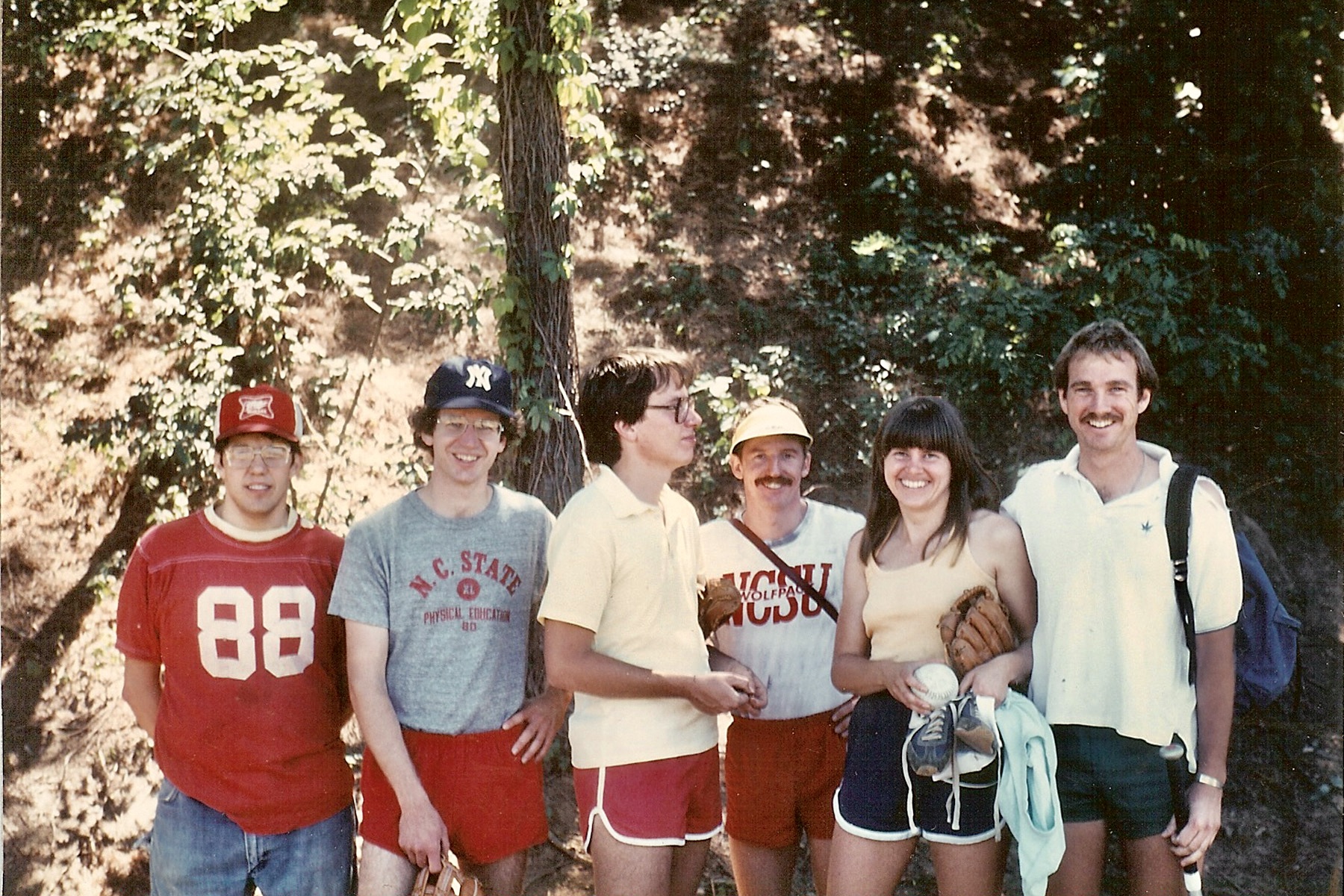
The Biochemistry coed softball team was not among the better softball teams in the School of Agriculture and Life Sciences (picture below of part of the team, I am on the far right). However, we had much more fun than every other team because we played for friendship and fun, not victories. And we had the best cheers, considering “2,4,6,8 tetrahydrofolate” (rhyming words underlined) and the classic, “Fatty acids, fatty acids, greasy!” (no rhyme intended). I repeat I am a science nerd/geek.
But the real lesson was pathways linked together for intermediary metabolism. These pathways describe the biochemical reactions that promote the generation of metabolic energy that converts nutritive material into cellular components. Therefore, intermediary metabolism describes macromolecules’ synthesis (anabolism or anabolic) and breakdown (catabolism or catabolic). It isn’t easy to appreciate in the image below, but imagine the detail and depth these Biochemical Pathways show in a full-scale poster.

“We need truth to grow in the same way that we need vitamins, affection and love.” Gary Zukav
Homocysteine and Why it is Bad: Cardiovascular diseases remain a leading cause of death in Western populations. One of the detrimental endpoints is arterial thrombosis and its many devastating complications.
Several risk factors promote arterial thrombosis, including type 2 diabetes, hypertension, obesity, hyperlipidemia, and tobacco use. Another factor that contributed to this event is increased levels of homocysteine. Even a moderate rise in homocysteine levels can promote thrombosis in a given person.
Remember, the Pathways described exist in our bodies; the system proceeds if a substrate is presented. And if an imbalance occurs, such as a vitamin deficiency, the pathways keep going. However, the result may be harmful to the host. So correct the imbalance, and the body returns to normal function.
“Compassion is subtler than Vitamin C, but both are real needs.” Deepak Chopra
Levodopa Metabolism and Transmethylation: I spent most of two sleepless nights making (but loving the challenge) the figure below. It shows three interconnected loops (or pathways), components of some metabolic pathways.

The left side is the all-important Levodopa metabolism pathway. For Parkinson’s, we want the Levodopa we ingest to reach the brain and be converted to dopamine by DOPA decarboxylase. For further information, please see “Purple Haze of Parkinson’s: How Dopamine Works.”
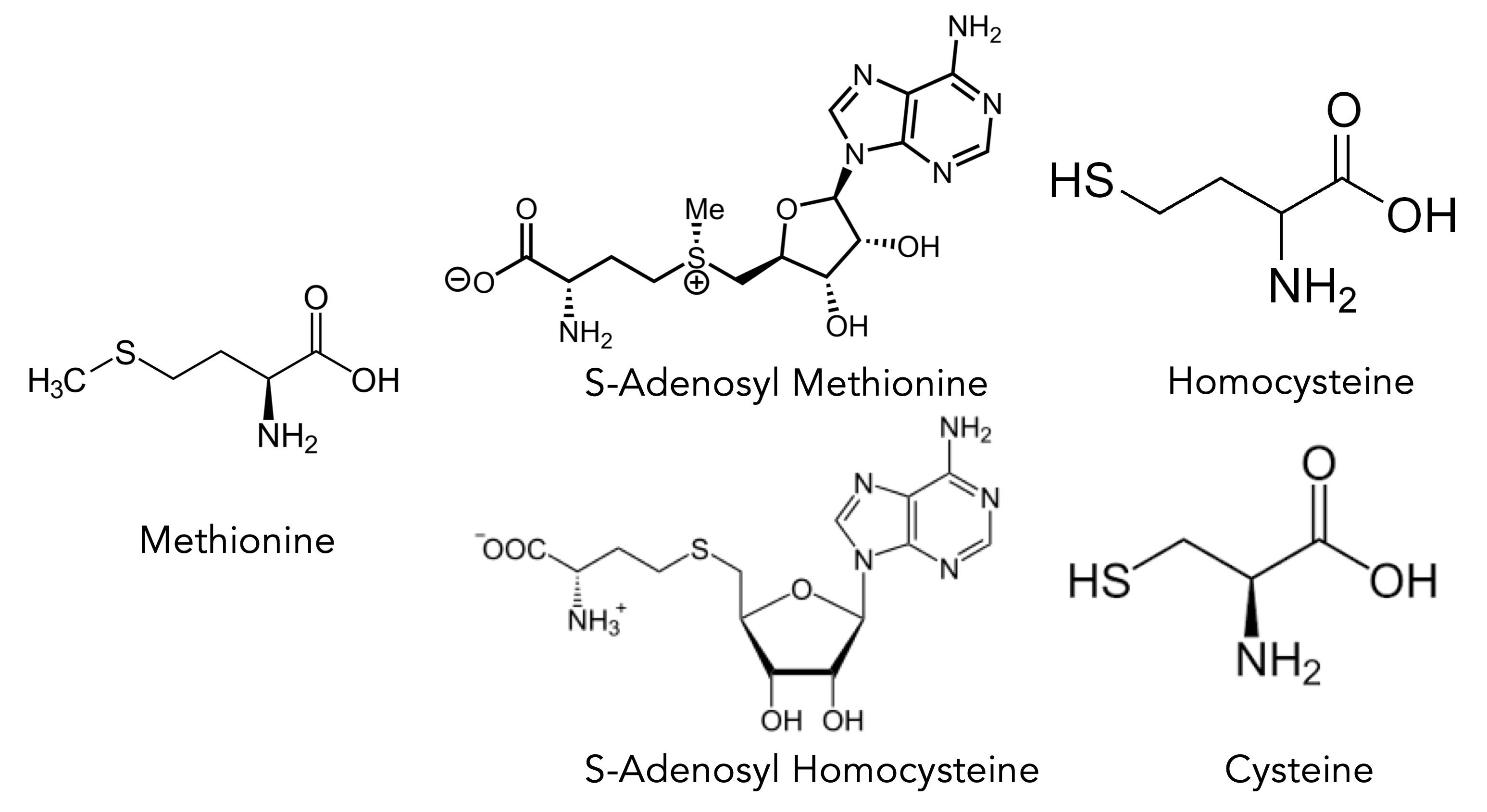
A different catabolic step for Levodopa is to be converted to 3-0-methyldopa, catalyzed by the enzyme COMT catechol-O-methyltransferase. This reaction proceeds if COMT has a methyl group donated from SAM or S-Adenosyl Methionine. For more information, please see “COMT Inhibitors in Parkinson’s: Tell Me More, Tell Me More” and “Addendum to COMT Inhibitors in Parkinson’s.” The chemical structures of the main constituents are given below.

“The excitement of vitamins, nutrition and metabolism permeated the environment.” Paul D. Boyer
Homocysteine Metabolism and Transsulfuration: The middle panel of the figure above contains two pathways, Homocysteine metabolism, and Transsulfuration. The goal is to break down the proteins we have ingested (for example) and use some of that energy for storage or building new proteins. Thus, we go from methionine to homocysteine to cysteine from the middle panel.
Along the way, we need to consume a little energy (ATP) by making SAM, which allows the body to donate a “methyl group” where required. In our case, we present it to COMT to generate 3-0-methyldopa from levodopa. Do you see how these pathways are linked and assist when needed? The complexity combined with the beautiful utility of metabolism our cells and bodies require. The chemical structures of the main constituents are given below.
The homocysteine is then converted to cysteine by a series of enzymatic reactions called Transsulfuration. You will notice that both enzymes require vitamin B6 as a cofactor for activity.
“[A vitamin is] a substance you get sick from if you don’t eat it.” Albert Szent-Gyorgyi
Remethylation: The third piece of the puzzle is given on the right side of the figure, termed remethylation. One of the goals of this cycle is to convert homocysteine back to methionine by a reaction catalyzed by methionine synthase. The enzyme methionine synthase needs vitamin B12 as a cofactor and uses 5-methyltetrahydrofolate as the methyl donor.
You will also see that the active folate (vitamin B9) form is tetrahydrofolate (THF). THF is a cofactor in several metabolic pathways, such as DNA and amino acid synthesis.
The interplay of these cycles constitutes our basal level of homocysteine.
“Pop music is aspirin and the blues are vitamins.” Peter Tork
Vitamin Definition: A vitamin is a nutrient the body needs in small amounts to function and stay healthy. We can not directly synthesize most vitamins; thus, the source of most vitamins are plant and animal food products and some food/dietary supplements. However, some vitamins are made in the human body from food products. Vitamins are either fat-soluble (can dissolve in fats and oils) or water-soluble (can dissolve in water).
“No evidence compels the conclusion that the minimum required intake of any vitamin comes close to the optimum intake that sustains good health.” Linus Pauling
B Vitamin Deficiencies Lead to Increased Levels of Homocysteine: If you are still reading, maybe you have enjoyed the puzzle presented by these three cycles in the figure above.
At any point in this process, if a vitamin deficiency occurs, this favors the continued generation of homocysteine. So look at the bottom of the figure, a vitamin B6 deficiency would not allow the cycle to make cysteine, and we would accumulate homocysteine.
Look at the interface between homocysteine metabolism and remethylation. If vitamin B12 is scarce, you will not provide the system with a way to detoxify the homocysteine by converting it to methionine.
Add finally, a folate deficiency would no longer be able to supply the THF needed for this all-important ability to transfer a methyl group. So again, more homocysteine is generated.
Reversing a vitamin deficiency by taking a supplement or enriching your diet would restore that cofactor to the system and correct the imbalance. Here, it would reduce the amount of homocysteine. The chemical structures of these B vitamins are given below.

“The real challenge for a vegan is getting vitamin B and omega-3s, but you can get those in a vegetarian supplement.” Emily Deschanel
Homocysteine and Neurological Diseases: Since the overall goal of this blog is related to Parkinson’s, I need to move back to the brain. If a deficiency of B vitamins leads to increased levels of homocysteine, how does this affect the neurological system? Here are some issues that potentially arise for someone with hyperhomocysteinemia:
- Microvascular stroke, which leads to white matter lesions;
- Severe vitamin B12 deficiency causes confusion, dementia, and neurologic damage, such as myelitis and peripheral neuropathy;
- Association of subtle but significant deficits in neurocognitive tests with low levels of vitamins B12, vitamin B6, or folate;
- Treatment of Parkinson’s with levodopa showed a 2-fold elevation of plasma homocysteine concentrations compared with untreated age-matched controls. The increase in homocysteine likely results from the left and middle panels in the figure, from the increased production of 3-O-methyldopa from SAM and COMT during the metabolism of levodopa.
“My kitchen bench is covered with vitamins and protein powders. I go through phases when I’m sure I’m taking too many – but I don’t get sick often.” Natalie Imbruglia
*Vitamin B Supplements: There is substantial evidence that long-term use of carbidopa/levodopa will increase homocysteine. And this can be reversed by supplementation with B vitamins. Interestingly, the U.S. government mandated the enrichment of grain products with folate (started 1996-1998). To show you that this is working, the yearly stroke mortality rate in the U.S. came down; however, in countries where this folate additive was not endorsed, the death rate did not change. Thus, if you consume bread products in the USA, you should not have a folate deficiency.
There are prescription drugs containing various amounts of folate, vitamin B6, and vitamin B12 to treat homocysteinemia, with the names Folgard, Folbic, and Folbee. As discussed by Ahlskog (2023), patients with chronic kidney disease are susceptible to vitamin B12 products containing cyanide, namely, cyanocobalamin. Therefore, it is better if you can find a vitamin B12 product with methylcobalamin.
A special note about vitamin B6. Do not take massive amounts over the minimal daily requirement. This is because vitamin B6 modifies the amino groups of lysine side chains and may attenuate the activity of this reaction, e.g., too much B6 may inactivate carbidopa from protecting levodopa. Please read the section on taking large amounts of vitamin B6, “B Vitamins (Folate, B6, B12) Reduce Homocysteine Levels Produced by Carbidopa/Levodopa Therapy” (click here to read this post).
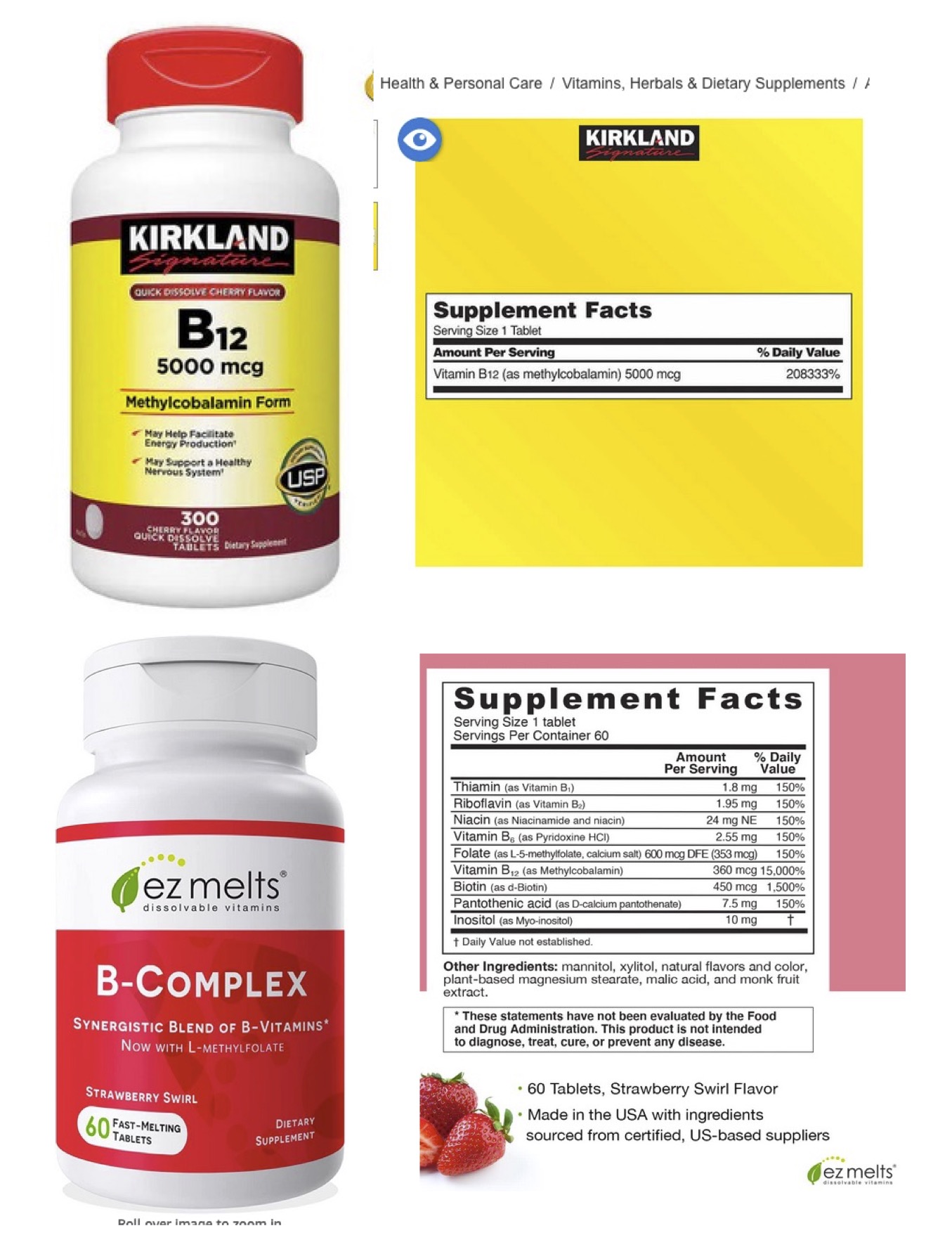
From reading the literature, the biggest concern is ensuring adequate vitamin B12. Although we have very little within us, and it has a very long lifetime in our bodies, preventing a deficiency is the goal. I am taking, sublingually, vitamin B12, pictured below (from Costco, https://shorturl.at/jrCZ6). This product contains 5000 mcg/tablet methylcobalamin (208333%). My plan for the summer is to have several factors/vitamins measured, including homocysteine, vitamin B1, vitamin B6, folate, vitamin B12, and several others. If I need further supplementation, I will take the product shown below, which contains several B vitamins that look very suitable in amounts of folate (353 mcg or 150%), vitamin B6. (2.55 mg or 150%), and vitamin B12 as methylcobalamin (360 mcg or 15,000%) [see below because this product contains several other B vitamins]. This sublingual product is from EZ Melts (obtained from Amazon. com, https://shorturl.at/nyJM8 ).
“Some guy invented Vitamin A out of a carrot. I’ll bet he can’t invent a good meal out of one.” Will Rogers
Conclusions: Our metabolic pathways function at all times. Taking a substance like levodopa could lead to potentially harmful side effects. Furthermore, vitamins are crucial substances that are needed but are rarely plentiful. The story here was not trivial. The depth and detail were undoubtedly present. Hopefully, you followed the storyline: chronic use of carbidopa/levodopa may lead to increased homocysteine levels. Finally, correcting a vitamin deficiency (folate, vitamin B6, and/or vitamin B12) is essential for one’s health.
*Medical Disclaimer: This blog post contains advice and information related to health care. It is not intended to replace medical advice. It should be used to supplement rather than replace regular care from your neurologist. You should seek your physician’s advice/approval before embarking on any new health plan or changes to your existing plan.
Useful References:
Ahlskog, J. Eric. “Levodopa, homocysteine and Parkinson’s disease: What’s the problem?.” Parkinsonism & Related Disorders (2023): 105357.
Boelens Keun, Jikke T., Ilse Ac Arnoldussen, Chris Vriend, and Ondine van de Rest. “Dietary approaches to improve efficacy and control side effects of levodopa therapy in Parkinson’s disease: a systematic review.” Advances in Nutrition 12, no. 6 (2021): 2265-2287.
Hu, X‐W., S‐M. Qin, D. Li, L‐F. Hu, and C‐F. Liu. “Elevated homocysteine levels in levodopa‐treated idiopathic Parkinson’s disease: a meta‐analysis.” Acta Neurologica Scandinavica 128, no. 2 (2013): 73-82.
Durand, Philippe, Michel Prost, Nadine Loreau, Suzanne Lussier-Cacan, and Denis Blache. “Impaired homocysteine metabolism and atherothrombotic disease.” Laboratory investigation 81, no. 5 (2001): 645-672.
Wu, Yue, Zhongting Zhao, Naidi Yang, Chenqi Xin, Zheng Li, Jiajia Xu, Bo Ma et al. “Vitamin B12 Ameliorates the Pathological Phenotypes of Multiple Parkinson’s Disease Models by Alleviating Oxidative Stress.” Antioxidants 12, no. 1 (2023): 153.
Al-Kuraishy, Hayder M., Ali I. Al-Gareeb, Yaser Hosny Ali Elewa, Mahmoud Hosny Zahran, Athanasios Alexiou, Marios Papadakis, and Gaber El-Saber Batiha. “Parkinson’s Disease Risk and Hyperhomocysteinemia: The Possible Link.” Cellular and Molecular Neurobiology (2023): 1-17.
Rahnemayan, Sama, Sasan Ghazanfar Ahari, Reza Rikhtegar, Sevda Riyahifar, and Sarvin Sanaie. “An umbrella review of systematic reviews with meta-analysis on the role of vitamins in Parkinson’s disease.” Acta Neurologica Belgica 123, no. 1 (2023): 69-83.
Periñán, María Teresa, Daniel Macías-García, Silvia Jesús, Juan Francisco Martín-Rodríguez, Laura Muñoz-Delgado, Maria Valle Jimenez-Jaraba, Dolores Buiza-Rueda et al. “Homocysteine levels, genetic background, and cognitive impairment in Parkinson’s disease.” Journal of Neurology 270, no. 1 (2023): 477-485.
Welch, George N., and Joseph Loscalzo. “Homocysteine and atherothrombosis.” New England Journal of Medicine 338, no. 15 (1998): 1042-1050.
Refsum, Helga, P. M. Ueland, O. Nygård, and S. E. Vollset. “Homocysteine and cardiovascular disease.” Annual review of medicine 49, no. 1 (1998): 31-62.
Muller, Thomas, Brigitte Weme, Brian Fowler, and Wilfried Kuhn. “Nigral endothelial dysfunction, homocysteine, and Parkinson’s disease.” The Lancet 354, no. 9173 (1999): 126-127.
Paul, Rajib, and Anupom Borah. “L-DOPA-induced hyperhomocysteinemia in Parkinson’s disease: Elephant in the room.” Biochimica et Biophysica Acta (BBA)-General Subjects 1860, no. 9 (2016): 1989-1997.
Miller, Alan L. “The methionine-homocysteine cycle and its effects on cognitive diseases.(Homocysteine & Cognitive).” Alternative Medicine Review 8, no. 1 (2003): 7-20.
McCaddon, Andrew, Peter Hudson, Gareth Davies, Alan Hughes, John HH Williams, and Clare Wilkinson. “Homocysteine and cognitive decline in healthy elderly.” Dementia and geriatric cognitive disorders 12, no. 5 (2001): 309-313.
Dufouil, Carole, Annick Alpérovitch, Véronique Ducros, and Christophe Tzourio. “Homocysteine, white matter hyperintensities, and cognition in healthy elderly people.” Annals of Neurology: Official Journal of the American Neurological Association and the Child Neurology Society 53, no. 2 (2003): 214-221.
“I believe that you can, by taking some simple and inexpensive measures, extend your life and your years of well-being. My most important recommendation is that you take vitamins every day in optimal amounts, to supplement the vitamins you receive in your food.” Linus Pauling
Cover Photo Image by Achim Scholty from Pixabay


Hi Prof. Church: thank you very much for the overview from 29 May 23 regarding B vitamin biochemistry. If you have any clinical sign and symptom updates around taking the supplements or any quantitative results of blood based assays, it would be quite helpful to know.
Thanks in advance,
Chris
LikeLike
Chris, check your inbox, best wishes, Frank
LikeLike
As an ER doc, I prioritize prevention. This article aligns with my belief in proactive healthcare. I’ve incorporated a B Complex supplement into my routine after long shifts, not just for me but as a lesson to my patients about the power of these vitamins in our overall well-being.
LikeLike
Dr. Coleman, thanks for your note. I applaud your attitude about prevention and the helpful role of B complex vitamins. Frank
LikeLike