

“For life and death are one, even as the river and the sea are one.” Khalil Gibran
“There’s a lot there to enlarge you. That’s part of the value of being in an extended family is that it enlarges you. It makes you bigger. It makes you more.” Jerry Garcia
Academic Life Components: Life in an academic setting follows a simple formula: you bring in grant support, then pay your salary and recruit others to do the science you’re interested in. My research lab group personnel changed and evolved every few years; undergraduates would stay for a year or more, postdoctoral fellows typically stayed 3 years, technicians worked until they found their calling (usually medical, dental, or graduate school), medical students would typically spend time between the first and second year of medical school, and then there were graduate students, striving for either the M.S. or Ph.D. degrees. They typically stayed in the lab group for 4-5 years.
“Death ends a life, not a relationship.” Jack Lemmon
Measuring Success of Laboratory Research Group: Success can be measured in many ways. How much grant money did you receive? How many publications did you have? When a lab group member left the lab, did they forge a successful career in science (whether in academia, industry, or the private sector)? In a relatively small lab group, I felt that having some kind of National Institutes of Health (NIH) funding was important, along with other funding sources, such as the Komen for the Cure (breast cancer) and the American Heart Association (AHA). For most of my career, this was achieved. In many cases, postdoctoral fellows and graduate students also sought their own funding, and when successful, it strengthened their careers and lightened my support burden. Over these years, my overall sense of the lab group is that we achieved much scientifically, and after they left, everyone succeeded in their own career paths in academia, industry, and the private sector. Each person who worked in this laboratory made me proud of their accomplishments, and they each made me smile as I reflected on their lives and worlds.
“Death cannot kill what never dies.” William Penn
Career Milestones: My career at the University of North Carolina at Chapel Hill (UNC-CH) spanned from 1982 to 2022. I started as a postdoctoral fellow in the Department of Pathology for three years (1982-1985). My mentor at UNC-CH was Dr. Roger L. Lundblad, one of the world’s experts on the protease thrombin.
I then spent a year as a research assistant professor (1985-1986), and then joined the tenure track as an Assistant Professor (1987-1993). During this stage of my career, I hired my first two employees: Herb Whinna, my first technician, and Dr. Charlotte Pratt, my first postdoctoral fellow. Throughout my career, I was blessed to recruit intelligent, talented, and hardworking people. Herb and Charlotte exemplified this. They set the tone for future hires and recruitment. Herb became my first graduate student and eventually earned his PhD and MD. Dr. Whinna is currently vice-chair of Pathology & Laboratory Medicine at UNC-CH and director of Hospital Laboratories at UNC Hospitals. Dr. Pratt left the lab 6 years later and became a well-known author of biochemistry textbooks. While they were in the lab group, their “hands” did the experiments, their “minds” answered the questions, and our “collective community” (i.e., extended family) provided the results forward. That gave way to funded research projects and the dissemination of our results at international meetings. Without their help, I would have achieved very little on my own.
As an Assistant Professor, you are expected to build a national reputation in your field. At the start of my 6th year, I presented my promotion seminar. I had funding from two NIH grants and the AHA, had recruited a lab group with several graduate students and postdoctoral fellows, and was the Associate Director of the Clinical Coagulation Laboratory at UNC Hospital Labs. Importantly, this was my most active period for publishing papers, as we published 34 peer-reviewed papers from 1987 to 1993. I was promoted to Associate Professor with tenure (1994-1998).
I was promoted to full Professor with tenure in 1999, and I held that rank until 2019. When I began this final promotion, I was 46 years old and had spent 20 years as a professor. Ultimately, I received my diagnosis of Parkinson’s on March 11, 2014. And five years later, the University approved my request for the phased retirement program (3 years at reduced effort, 50%).
“You don’t have to give birth to someone to have a family. We’re all family – an extended family.” Sandra Bullock
Reflecting on the Laboratory Group: As an academic biomedical researcher, I had a fulfilling career training over 100 scientists in my research laboratory (17 graduate students, 12 postdoctoral fellows, 62 undergraduates, and 17 medical students). I was very proud of the collective lab group members over the years. The group was diverse in personality and life experience, and while their reasons for working in a laboratory were sometimes similar, their career expectations were often unique.
The laboratory group ranged from about 5-12 people, depending on funding and where we were in the process of recruiting new personnel. So, not only was there a battle against many other lab groups in the U.S. for federal grant support, but there were also challenges with many of the same groups for recruiting new postdoctoral fellows and for getting a first-year graduate student to rotate in the laboratory and then decide to stay for their PhD. I was never quite sure how we recruited such a stellar group of people to the laboratory, but for me, it came back to the quality of our science and the sincere depiction of how the lab group existed as a collective community that could be called an extended family.
“Friends are the twenty-first-century version of extended families.” Cynthia Heimel
The Loss of Former Laboratory Group Members: As we age, no doubt we will experience the death of friends, colleagues, acquaintances, and family members. While death is inevitable, it is frequently not expected in those younger than yourself. Maybe I have been fortunate, but to date, there have been two deaths of former lab group members.
“Time is a great teacher, but unfortunately it kills all its pupils.” Hector Berlioz
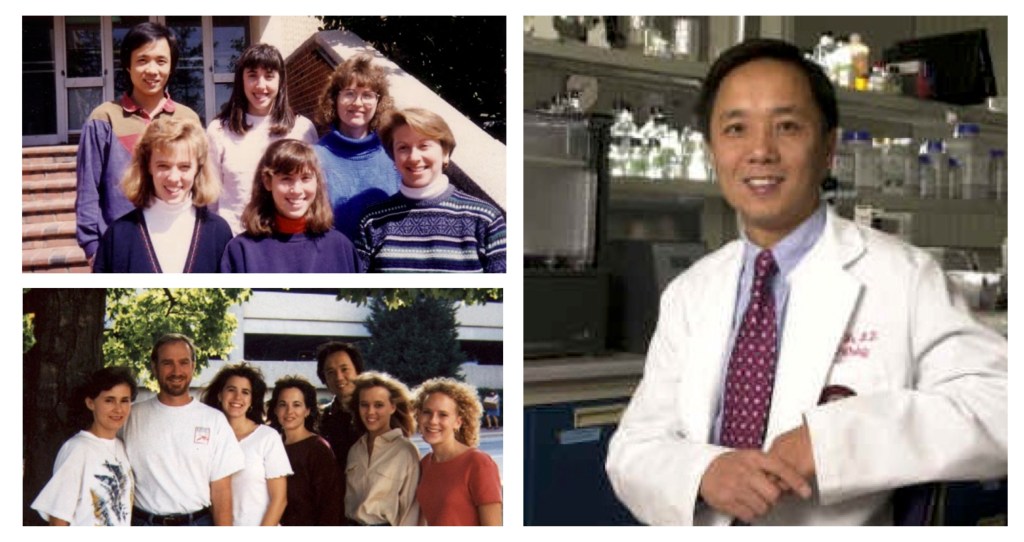
In Memoriam: Haifeng M. Wu, M.D.
Haifeng earned an M.D., trained in China, and came to the U.S. for postdoctoral training. Haifeng worked in the lab from 1993 to 1998. He was both intelligent and resourceful. With his skills, we mapped the heparin-binding site of lactoferrin. We published this work and received a U.S. patent on this heparin-binding action: U.S. Patent No. 5,712,247, entitled “Use of Lactoferrin to Modulate and/or Neutralize Heparin Activity,” issued by the U.S. Patent Office (1998). We even secured industry funding for projects with clinical potential, but unfortunately, the company failed in other endeavors.
One summer, I asked Haifeng to work with a summer undergraduate student, Aimée Crago, who, as I recall, was a Math and Music double major at Tulane University (Aimée M. Crago, MD, PhD, FACS is currently a board-certified surgeon, surgical oncologist, and researcher at Memorial Sloan Kettering Cancer Center and an Associate Professor of Surgery at Weill Cornell Medical Center in New York). Her summer project was to evaluate thrombin’s chemotactic activity on monocytes. With help from our long-time collaborator, Dr. Maureane Hoffman, we published this paper: Crago, A. M., Wu, H.-F., Hoffman, M., Church, F. C., 1995. Monocyte Chemoattractant Activity of Ser195 → Ala Active Site Mutant Recombinant α-Thrombin. Experimental Cell Research. 219, 650-656.
This was a very challenging research project; drawing blood from volunteers to isolate mononuclear cells and then assembling the cell-motility (chemotaxis) equipment were not considered ‘easy tasks.’ At one point, Haifeng came up to me, as he and Aimée were formatting some results, and he remarked, “Aimée is very intelligent, and she is both stubborn and determined. She is getting some very interesting and important results.” I looked up to him and thought, “Very intelligent, stubborn, and determined” could easily describe Haifeng himself. And I knew he would become an excellent advisor for students in the future.
Haifeng shared his recipe for General Tso’s Chicken with me and, one night, helped me cook the dish. On the infrequent occasions when I get Chinese food, I always order General Tso’s Chicken and think of Haifeng.
Haifeng always sought to apply his clinical training; he completed residency training in Pathology at Duke and Columbia Universities, and in 2001, he became an Assistant Professor at Ohio State University. In 2008, he was promoted to Associate Professor with tenure, and in June 2015, to full Professor with tenure.
Haifeng, at the age of 54, passed away on July 27, 2015, after a courageous 5-year battle with cancer. Haifeng is survived by his wife, LiHui Xu; daughter, Trudy C. Wu; and son, Alexander Y. Wu.
The last time I was with Haifeng was at a delightful dinner in Amsterdam, the Netherlands, in 2013 for the International Society on Thrombosis and Hemostasis Congress. It was clear his health was in decline, but he was valiant and fought hard throughout his life. His passion for science and medicine was always evident in his life and career. It was so nice to hear about his academic accomplishments; I appreciated all of his successes. He had achieved a lot before his passing, and it was clear his future at Ohio State was focused on hematology and working with both hospital and medical school staff and students.
“I am I and you are you, whatever we were to each other that we still are.” Henry Scott Holland
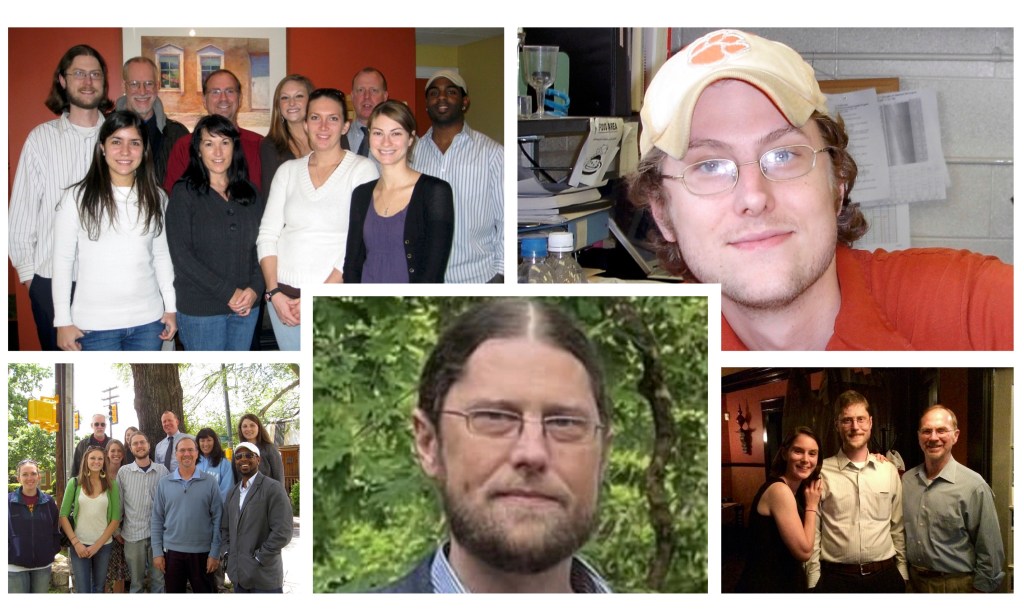
In Memoriam: Mark W. Gramling, Ph.D.
Mark W. Gramling was born and raised in South Carolina. Mark attended Clemson University as a Clemson National Scholar. For three years, he was also a member of “Tigeroar,” Clemson’s premier male a cappella group. He graduated from Clemson in 2005, and he received the Phi Kappa Phi Award for Highest Academic Achievement.
From Clemson, Mark entered UNC-CH to pursue graduate studies in the Department of Pathology and Laboratory Medicine. Recognized as a top graduate student, Mark received a prestigious University-wide Thomas and Carolyn Royster Fellowship. After completing the required rotations, Mark chose this research group for his PhD training. In addition to research, Mark was very interested in fulfilling the teaching assistant duties expected of our graduate students.
Between 2007 and 2012, we had graduate students successfully defend their dissertation projects in the laboratory, including: Dr. Lea Beaulieu (2007), Dr. Jill Rau (2008), Dr. Jennifer Carter (2009), Dr. Mark Gramling (2010), Dr. Troy McEachron (2011), and Dr. Jessica Cardenas (2012). This group of graduate students accounted for 27 publications either as first author or co-author. Equally impressive, this group of graduate students had 34 abstracts presented at internationally recognized meetings.
It was clear to me that Mark was remarkably intelligent. His ability to explore and understand the various signaling cascades in cancer cells matched his capacity for deep organization. He was truly devoted to understanding many key concepts in cancer pathogenesis. Unfortunately, my lab was not fully invested in cancer pathobiology, but we did explore facets of cancer biology that complemented our interest in thrombosis and fibrinolysis. Would Mark have been better off in a more focused cancer group? He never said otherwise. He seemed focused, knowledgeable, and involved with everyone’s project.
Mark was devoted to education and helped wherever he could. He was especially proud to mentor two undergraduate students (now Dr. Leah Hawkins and Dr. Emir Sandhu, both of whom attended Harvard University for medical school) and keep them engaged in their research.
Mark was a gifted musician and a talented singer. Outside the University, he had a devoted group of people who admired his musical abilities. I remember walking into a vintage guitar store in New Orleans’ warehouse district with him. Nothing made Mark happier than a vintage guitar. I promised Mark I would attend one of his weekly performances at a downtown bar in Chapel Hill. I did, and it was remarkable to see Mark perform. Performing in front of a crowd of admirers totally transformed the Mark I knew as a scientist. He was happy here.
While in Chapel Hill, Mark met his future wife, Jennifer Ann Muller. Jennifer taught in Durham, NC. They were married on June 18, 2011, in Charlotte, NC. Mark and Jennifer moved to Nashville, TN, so that Mark could pursue postdoctoral training at Vanderbilt University Medical Center. While at Vanderbilt, he was awarded two National Institutes of Health grants to develop research. Mark was never happier than when he was with Jennifer; she bolstered his strengths and helped him better handle his few weaknesses.
I last saw Mark when I attended a medical education meeting in June, 2014 in Nashville, TN. During this visit to Nashville, Mark, Jennifer, and I had a wonderful dinner one evening, mostly reminiscing about Chapel Hill. As he spoke about it, Mark was excited and motivated by his work with the Larvol Group in Oncology.
At the age of 43, Dr. Mark W. Gramling passed away from cancer on Thursday, May 7, 2026, in Nashville, TN. Mark is survived by his wife, Jennifer Muller Gramling of Nashville, TN; his parents, the Reverend Dr. and Mrs. Roger M. Gramling of Irmo, SC; and a brother, Lt. Col. (USA Ret.) David W. Gramling(Ann) of Brandenburg, Kentucky
Mark always reminded me that when you looked into his eyes, you were encountering a wise old soul in a young man’s body. I could easily imagine Mark as the esteemed Biochemistry professor with a ponytail and wire-rimmed glasses, wearing a plaid jacket with elbow patches, hosting an exam review session in his office. Students attended to learn from Professor Gramling, as he was proud to cover the important aspects of cancer to help them understand this wicked disease process. Sadly, only my imagination can bring Dr. Mark W. Gramling back now.
“But anyway, it’s obvious through human experience that extended families and tribes are terribly important. We can do without an extended family as human beings about as easily as we can do without vitamins or essential minerals.” Kurt Vonnegut
A Closing Thought: We all cross paths with death; it is a constant of our lives, especially as we get older. Both Haifeng and Mark had vital roles in the life of the laboratory. Their individual contributions made us better, and I will never forget their presence or the memories we shared.
“There will be no one like us when we are gone, but then there is no one like anyone else, ever. When people die, they cannot be replaced. They leave holes that cannot be filled, for it is the fate – the genetic and neural fate – of every human being to be a unique individual, to find his own path, to live his own life, to die his own death.” Oliver Sacks
Cover photo credit to Frank C. Church

