

“Ability is what you’re capable of doing. Motivation determines what you do. Attitude determines how well you do it.” Lou Holtz
“Do not let what you cannot do interfere with what you can do.” John Wooden
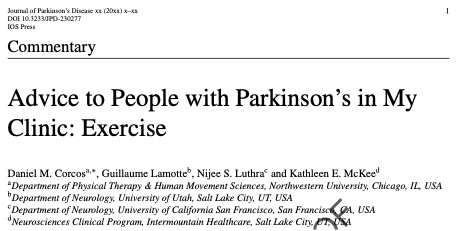
A New Paper Describing the Benefits of Exercise in Parkinson’s: Corcos et al., (Corcos, D.M., G. Lamotte, N.S. Luthra, and K.E. McKee, “Advice to People With Parkinson’s in my Clinic: Exercise,” J Parkinson’s Disease, DOI: 10.3233/JPD-23027, vol. Pre-press, no. Pre-press, pp. 1-9, 2023). You should bring this paper to your Neurologist, movement disorder specialist, or any other professional dedicated/committed to helping people with Parkinson’s (PwP). Our journey to use exercise to slow the progression or even reverse the symptoms will differ from individual to individual. Still, human clinical trial results reinforce the animal model results from a few years ago; now, the mantra saying that exercise is medicine is ringing even truer for Parkinson’s.
“Patients should have rest, food, fresh air, and exercise – the quadrangle of health.” William Osler
What to do, what direction to follow, where to begin? Start here with this paper cited above. This is a well-written article that gives:
- A good overview of what has been accomplished in terms of new exercise paradigms.
- A description of exercise/physical activity guidelines for older adults and those with Parkinson’s.
- What each person-with-Parkinson’s (PwP) needs to consider to prepare to exercise.
The importance of any work describing the health benefits of exercise against Parkinson’s is getting the PwP to buy into such a concept is never a trivial pursuit. The most straightforward conclusion reached here and by many others is that changing a lifestyle to adopt a pattern of exercising almost daily is never easy.
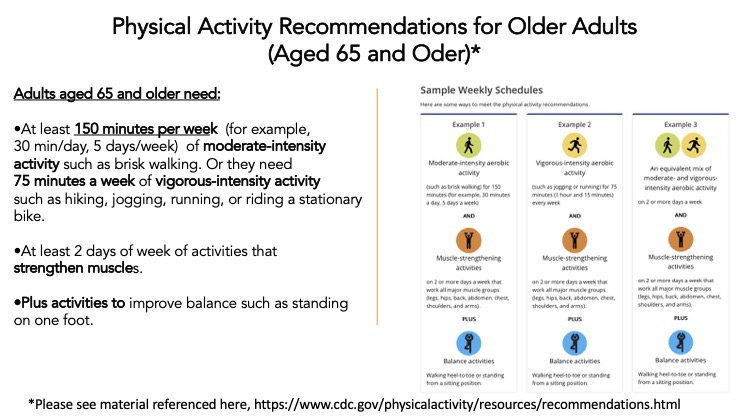
Perhaps the most challenging concept to accept is that anyone over 65 is already supposed to exercise regularly (see the schematic below (presenting the basis of the accepted guidelines and the idea behind three different types of exercises needed weekly). For most who try to adapt and change their lives to embrace exercise with Parkinson’s, the benefits far outweigh the uncomfortable feeling of beginning this new adventure of daily workouts.
“Lack of activity destroys the good condition of every human being” Plato
Exercise Can Make a Difference to Your Quality-of-Life with Parkinson’s: In elementary school, we always had a Physical Education class; for me, it seemed to go through high school. That may have been your last time to exercise for many of you. However, for many more, over the years, you have started an exercise routine, tried it for a while, and then quit.
Thus, if you are in either of the above-described categories, think of exercise now as a lifeline off the bow of the cruise ship; if you start now, you’ll be able to climb up the lifeline rope easily with practice and get the rewards the cruise ship offers. Maybe that is a silly example, but starting to exercise at 60 is not accessible for many people. I remember saying this a few years ago, “Since receiving my Parkinson’s diagnosis, my opinion of exercise has changed. With Parkinson’s, I’m now exercising as if my life depended on it.” I need to kick start myself in 2024, which is one of the reasons for writing this blog post; however, at any age or level of prior exercise, it is an important and life-changing event to start exercising to help reduce your Parkinson’s symptoms.
Mouse Versus Human: We always want our physicians to know what’s best for us, right? I think the changing view from a medical standpoint is that a few years ago, there was dramatic data with mouse models of Parkinson’s and using exercise for treatment. There are far too many scientists to cite and mention here to give justice to this fantastic research. We said it this way previously, “These animal models collectively reinforce the evidence that exercise’s anti-inflammatory properties can potentially be harnessed in a neuroprotective role, mitigating the immune system’s neuroinflammation that is characteristic of PD. Importantly, mouse models provide mechanistic insight into how exercise promotes change at the molecular, cellular, and neural network levels [79].” (cited from Hall, M.-F.E., and F.C. Church. Exercise for Older Adults Improves the Quality of Life in Parkinson’s Disease and Potentially Enhances the Immune Response to COVID-19. Brain Sciences 10.9 (2020): 612. https://www.mdpi.com/2076-3425/10/9/612)
“Exercise of the muscles keeps the body in health, and exercise of the brain brings peace of mind.” John Lubbock
Exercise as a Prescription for Parkinson’s: In 2020, Alberts and Rosenfeldt wrote a review about the human clinical trials showing the benefit of aerobic exercise in treating Parkinson’s (Alberts, Jay L., and Rosenfeldt, Anson B. ‘The Universal Prescription for Parkinson’s Disease: Exercise’. 1 Jan. 2020 : S21 – S27). Getting such results takes time, effort, well-designed studies, and hard work. What is becoming more explicit about the “benefit” of exercise is the need for intensity, frequency, and duration. That translates into getting moving and getting your heart rate elevated. It is not a stroll on the beach or a short walk with your dog. Unfortunately, translating the data into results suggests getting your heart rate up to 70-85% of your maximum heart rate for 30-40 min thrice weekly.
In the paper I mentioned at the beginning, Corcos et al., “Advice to People With Parkinson’s in my Clinic: Exercise,” carefully present a plan to follow to achieve the mantra that exercise is medicine for Parkinson’s. Yes, it suggests many aerobic exercises and elevating your heart rate. Still, it also incorporates other activities and clinical help from therapists to deal with Parkinson’s specific events. However, embracing their idea for an exercise-based prescription for Parkinson’s will demand time, effort, and a renewed commitment to endorse exercise and its potential to help slow the progression of Parkinson’s and help ‘heal/repair’ some of its damage along this long path with the disorder.
IMPORTANT NOTE- Medical Disclaimer: This blog post contains advice and information related to health care. It is not intended to replace medical advice. It should be used to supplement rather than replace regular care from your neurologist. Please seek your physician’s advice/approval before embarking on any new health plan or changes to your existing plan/routine, especially as mentioned here regarding elevating and sustaining your heart rate at such a high level by aerobic exercise.
“The secret of getting ahead is getting started” Mark Twain
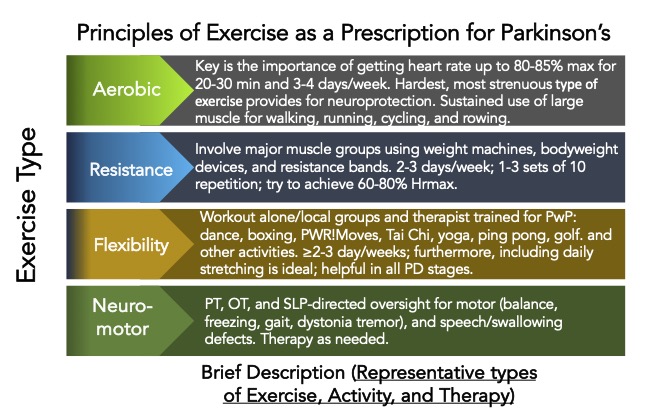
Use Exercise to Help with Motor and Non-Motor Symptoms: There is now convincing evidence that strenuous exercise can help with Parkinson’s motor and non-motor symptoms. Corcos et al. spell out the need for four types of exercises to help rehabilitate and manage the symptoms of Parkinson’s. I like their presentation and justification. I summarized their work in the following schematic.
The difficulty in adapting this exercise routine is making time to exercise daily. I know that I have the time; I genuinely buy into the importance of exercise to help manage Parkinson’s, yet here I am again, writing to remind myself, commit, commit; the time is there, and the results await my effort.
The utility of their description of the four types of exercises gives us a wide choice of options; however, the top two require significant effort and time. And just as I mentioned above in the ‘Medical Disclaimer,’ this is the time to discuss aerobic exercise and resistance weight training with your physicians and family. One aspect of the training schedule not discussed is the continuing cross-over events covered by many practitioners of the exercises focused on flexibility exercises; by that, I mean routines that incorporate both flexibility and aerobic/resistance-based exercises together—the best of all worlds.
The target audience for Corcos et al. is the Movement Disorder physician and all affiliated specialists (Physical Therapists, Occupational Therapists, and Speech-Language pathologists) to join forces to prescribe exercise more frequently in their treatment plans for PwP. It spells out a rigorous number of exercises that could help deal with motor and non-motor symptoms, concluding that there is still hope for exercise to prove to be neuroplastic. This paper, they hope, will serve as a guideline-based presentation to help jump-start their use of exercises for treating Parkinson’s.
“In golf, as in life, you get out of it what you put into it.” Sam Snead
The Choice to Use Exercise in Parkinson’s is Ours: Not mentioned in this work is the integrative approach to managing Parkinson’s, more specifically, using traditional and non-traditional pathways to manage Parkinson’s. The difficulty in advancing any of this material is the complexity of Parkinson’s as a human disease. It has features that promote and support both chronic and progressive neurodegenerative processes. However, I firmly believe that adopting a multi-pronged approach to dealing with Parkinson’s offers us the best path to follow in maintaining an edge over Parkinson’s. We must embrace that to maintain the best possible level of health and wellness with Parkinson’s; we must be aware of our physical, mental, social, and emotional factors for day-to-day life. Exercise is important. And the element of exercise is crucial to incorporate anyone managing their response to their Parkinson’s.
I still believe what I have said remains the same, with the most significant change being increased/sustained aerobic exercise. The hopeful goal is that exercise will give you healthier lives, allowing you to negotiate a better life on your terms, not Parkinson’s. These observations about exercise and brain disorders are vital because they genuinely reflect the importance of exercise in treating Parkinson’s.

“I am sick and tired of being sick and tired.” Fannie Lou Hamer
The Fitness Expert, Jack LaLanne: Growing up in the 1950s-1960’s in the USA, we always saw Jack LaLanne doing something as he got older. According to Wikipedia, “LaLanne hosted the first and longest-running nationally syndicated fitness television program, The Jack LaLanne Show, from 1951 to 1985.” As a young boy, I was never very interested in hearing about Mr. LaLanne’s adventures. But now, as an older adult, I marvel at his ability and advice about the vital role of exercise and diet associated with staying and remaining healthy as we age. I close this blog post with some of Jack LaLanne’s quotes as a reminder of the possible picture we can envision of ourselves and friends to maintain ourselves in the best possible manner, but there is no easy path taken. Exercise, sleep well, eat right, and your health will improve. These are all admirable goals as this new year begins, and to remind me, it takes belief, commitment, and effort to exercise as described here. Good luck and happy health to all.
“Most people, when they reach a certain age, let down and talk about what they used to do. Well, who gives a damn about what you used to do? It’s what you’re doing now.” Jack LaLanne
“Your muscles know nothing. It’s your brain. Exercise is something you’ve got to do the rest of your life. It’s a lifestyle. Dying is easy. Living is a pain in the neck. You’ve got to work at it.” Jack LaLanne
“Progress is made where progress is measured.” Jack LaLanne
“Virtually everything we do in life is a matter of habit. Habits make us who we are. Why not change your habits to better your life?” Jack LaLanne
“Your age is the sum total of your physical condition, the condition of your mind, and how you feel.” Jack LaLanne
“As it’s often been said, the rest of your life is the best of your life. I’m reaching for your hand now to help you reassess your attitude on living and jump into the happiest, healthiest, most productive years you will ever have.” Jack LaLanne
Cover Photo Image by Paul Brennan from Pixabay
 Journey with Parkinson's
Hi, Dr. Church!
This is such a great post. I really enjoyed the chart that you included. It really made it easy to understand the benefits of exercise. I also agree with you on the importance of committing to an exercise routine. In my experience, it’s easier to keep fitness commitments when you make them with a friend. Also, thank you for sharing the timeless wisdom of Jack LaLanne. He’s not spoken of much these days, so it was refreshing to see his quotes at the end of the article.
LikeLike
Thanks Jackie, I need to go back and read this blog now that warmer weather is arriving, time for a re-commitment to exercise more. Appreciate your comments.
LikeLike