

“We make our way through everything like thread passing through fabric, giving shape to images that we ourselves do not know.” Rainer Maria Rilke
“You can’t use up creativity. The more you use, the more you have.” Maya Angelou
Prelude: Do you remember the Moody Blues? Did you ever listen to their music? An interesting, intriguing, creative, and very talented group (well, I thought they were). Richard McCook said, “The Moody Blues used elaborate concept albums to weave together personal emotion with grand philosophical and spiritual ideas, making them pioneers of progressive and psychedelic rock.” A classic example of this type and theme in their music is the album “Days of Future Passed,” released in 1967. The themes of the album centered on journey, time, the changing seasons, and contrasting perspectives.
For me, in the early 1970s, Moody Blues music time was always reserved for those introspective moments, always late at night with the turntable playing the record, and what you thought were decent headphones, listening to their music, my reflective and imaginative mind time. During these times of reflection, the music allowed me to “solve” the problems of that day; things like how to end the Vietnam war, the growing divide between people and the color of our skin, and the anxiety generated by my Selective Service “lottery” number and would I be drafted this year (1971-1972) and sent to basic training and then quickly shipped off to Vietnam?
“Cold-hearted orb that rules the night / Removes the colors from our sight / Red is gray and yellow white / But we decide which is right / And which is an illusion.” The Day Begins
A New Beginning: When you first hear of your diagnosis, “You’ve got Parkinson’s disease,” you are really not sure what to make of it. The news likely explains how you have been feeling recently, yet the unknown and uncertain future sets off a downward spiral. In the first few years, your body responds relatively well to a dopamine agonist, usually at first, and then, slowly, you are brought onto carbidopa-levodopa. Likely, the tremor is under control, and the assortment of symptoms varies widely amongst individuals with Parkinson’s. As we walk down the Parkinson’s path, I stand in awe of everyone as they deal with, manage all of the complications, and live with and through this disorder.
“You’re here today / No future fears / This day will last / A thousand years / If you want it to” Dawn Is a Feeling
Brain Biochemistry- Making Dopamine: One of the first things you read about upon learning about Parkinson’s is the importance of dopamine. Dopamine is a drug in the brain, acting as a chemical messenger for pleasure, reward, motivation, movement, mood, and learning. It also seems that getting too much dopamine could lead to aggressive behavior. As a biochemist, I see dopamine as a molecule that evolved from the enzymatic modification of the amino acid L-Tyrosine:
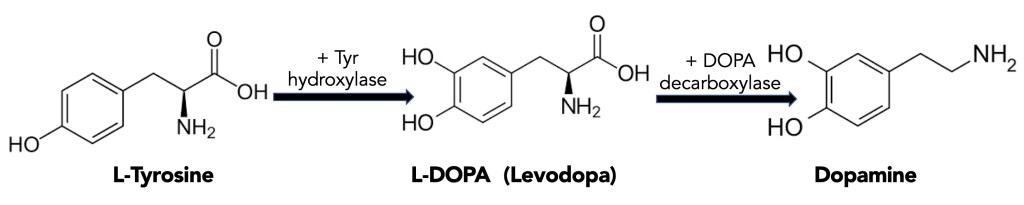
The power of the machinery and mechanism of a specific type of neuron is designed to modify tyrosine to make a relatively simple substance by using enzymes to add an -OH group, and then removing a COO- group to create a neurotransmitter with such resounding power and importance as dopamine. There is no redundancy here, no replacement that our bodies possess to replace dopamine when it is absent.
And when you consider this unique ability of an irreplaceable substance present throughout our makeup, it becomes clear how vital these elements are. We have no substitute for insulin, and its absence causes type 1 diabetes. We cannot replace hemoglobin in red blood cells, which carry oxygen throughout our bodies, leading to hypoxia. Our energy source is the adenosine triphosphate (ATP) molecule, for which we have no alternative. The significance of these substances, without redundancy, underscores the crucial need to maintain their synthesis; a reduction in their production results in serious disorders.
“I’ve shattered the illusion / of fortune and of fame / I’m waking up” Another Morning
Brain Physiology: Dopamine Receptors: Making dopamine is a source of action that provide connections. The consequences of the action of dopamine reside in its binding to a cell surface protein, a receptor we simply call a dopamine receptor. There are five such dopamine receptors. Many years ago, in a post entitled “Purple Haze of Parkinson’s: How Dopamine Works” (click here), I used an analogy that dopamine was a single key. that recognized 5 different locks.
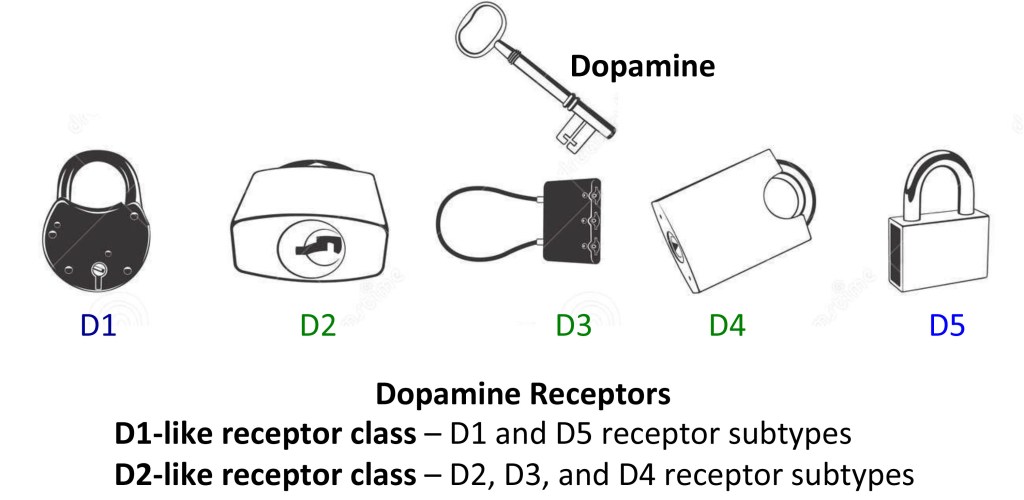
Of course, the binding of dopamine to each dopamine receptor unlocks an amazing array of biochemical substances that generate cellular signals that lead to synthesis of downstream molecules that determine the function of that dopamine binding to that specific receptor. A brief side note, the dopamine agonists are designed to bind these dopamine receptors.
The wonder of dopamine binding to its receptors is that they are all G protein-coupled, which provides a unified signalling process in which the appropriate receptors respond when dopamine is present.
“I’m just beginning to see / Now I’m on my way / It doesn’t matter to me / Chasing the clouds away” Tuesday Afternoon
Brain Anatomy- Nigrostriatal Pathway: The substantia nigra is in the midbrain of each hemisphere. There are two parts, the pars compacta and the pars reticulata. Importantly, the substantia nigra pars compacta is composed of a thin band of cells, and here there are approximately 200,000-420,000 dopamine-producing cells. The pars compacta forms the nigrostriatal pathway, which supplies dopamine to the striatum, relays information to the basal ganglia, and then both activates and inactivates motor units. But how?
The five dopamine receptors are grouped into two types, D1-type and D2-type receptors (see the figure above). Somehow, when dopamine is made in the pars compacta region of the substantia nigra, it encounters a region in the caudate nucleus and putamen enriched with D1-type dopamine receptors. These neuros hve projections with GABAergic cells in the para compacta region of the subsantia nigra and the internal segment of the globus pallidus. This process, which is termed the Direct Pathway, enables the thalamus to engage motor neurons and drive movement. By contrast, another region of the striatum enriched in D2-like dopamine receptors projects to a different region, the external region of the globus pallidus and the subthalamic nucleus. When dopamine recogizes these D2-like dopamne receptors, the Indirect Pathway, sends signals to the pars reticulata of the substantia nigra, which then suppresses the thalamus and inhibits motor neurons.
Hopefully, you can admire the sheer wonder and beauty of the brain as it completes planned movement; yet, this dynamic process is quite fragile and easily harmed by exposure to environmental toxins and many other processes that promote dopaminergic neuron death.
“Minds are subject to what should be done / Problems solved, time cannot be won”.Peak Hour
Brain Pharmacology–The Importance of Levodopa: The framework to understand how Parkinson’s disease begins its weaving pattern by following what dopamine does. We have known this pattern of fabric for over 50 years, as levodopa has been the primary therapy for many years following diagnosis.
First, our bodies are not built for a long, slow process that somehow selectively destroys dopamine-producing neurons, leading to Parkinson’s. Second, the typical neurobiological process involves producing a small but steady amount of dopamine, which is crucial for fine motor skills. This requires a specific dosing strategy to maintain quality of life. We need large doses of carbidopa/levodopa that flood the dopamine-receptor neurons over time, eventually causing harmful side effects of therapy. Third, we now have a range of treatments, including extended-release forms of levodopa/carbidopa (Crexont and Rytary), newly developed drugs that sustain dopamine production (MAO-B inhibitors), compounds that prolong levodopa’s plasma lifetime (COMT inhibitors), and devices that deliver a steady, small amount of levodopa (Duopa, an enteral suspension pumped into the small intestine).
“Just what you want to be / you will be in the end” Nights in White Satin
What is the meaning of the Days of Future Passed by the Moody Blues: Using AI, one gets an enriched and detailed story behind the meaning of the Days of Future Passed (click here). One thought was that it represents the cycle of life from a single day, which is linked to the journey of our lives. Partly, it is suggested that the energy we had in our early lives is diminished and extinguished as we age. Some sage words from the album go: “Breathe deep the gathering gloom, / Watch lights fade from every room. / Bedsitter people look back and lament, / Another day’s useless energy spent. / Impassioned lovers wrestle as one, / Lonely man cries for love and has none. / New mother picks up and suckles her son, / Senior citizens wish they were young.” Late Lament (from Nights in White Satin)
What Does Parkinson’s Feel Like: To me, the on-off cycle of carbidopa/levodopa in Parkinson’s feels like the remaining fragments of logs from a long-burning wood fireplace. However, stirring the embers and adding more logs sparks a slow, growing flame, and the warmth lasts for a while. But by morning, as the wood is burned up, you’re left with a pile of ashes. So, we add more wood, and the fire is rekindled along with its warmth.
What I have NOT been trying to do in describing the various aspects of dopamine biology is to blend myself into the philosophical and spiritual feel of a Moody Blues song. No, I had two parallel storylines: one tracing the Moody Blues’ work and the other outlining the role of dopamine in Parkinson’s. Hopefully, you learned something new from one or both stories.
Tracklist for Days of Future Passed:
The Day Begins (includes “Morning Glory”)
Dawn: Dawn Is a Feeling
The Morning: Another Morning
Lunch Break: Peak Hour
The Afternoon (includes “Forever Afternoon (Tuesday?)” and “Time to Get Away”)
Evening: The Sunset / Twilight Time
The Night: Nights in White Satin (includes “Late Lament“)
The complete album of “Days of Future Passed” byThe Moody Blues
“I spent a lot of years trying to outrun or outsmart vulnerability by making things certain and definite, black and white, good and bad. My inability to lean into thiscomfort of vulnerability limited the fullness of those important experiences that are wrought with uncertainty: love, belonging, trust, joy, and creativity, to name a few.” Brené Brown
Cover photo image by JoergSchulze from Pixabay
 Journey with Parkinson's