

“The mind is just another muscle.” Ted Turner
“Courage is very important. Like a muscle, it is strengthened by use.” Ruth Gordon
Introduction: This is a complicated blog post. Ponder these scenarios: (A) an older adult, healthy and aging naturally with evidence of decreased thigh muscles. This patient has a disorder named sarcopenia. (B) A person with Parkinson’s (PwP) who is otherwise healthy. And (C) an older PwP with sarcopenia. The goals of this blog post are to (i) introduce sarcopenia, (ii) the detriment of a PwP with sarcopenia, and (iii) describe the use of calcium beta-hydroxyl-beta-methylbutyrate (HMB) and vitamin D3 in an older adult setting, and potentially to improve muscle function and mass in a PwP with sarcopenia.
“Great ideas originate in the muscles.” Thomas A. Edison
Loss of Muscle Strength Associated with Aging: Muscle strength is vital to many aspects of our lives as we age. The loss of muscle mass, as identified by sarcopenia, is usually considered the reason for age-linked loss of muscle strength. However, Goodpaster and associates (2008)* argue that age-related changes to muscle quality may contribute to muscle strength loss. In an outstanding paper, they showed that modest physical activity with structured exercise showed an increase in muscle strength and decreased muscle fat.
*References are at the bottom of the blog post in their order of appearance in the post.
“A muscle is like a car. If you want it to run well early in the morning, you have to warm it up.” Florence Griffith Joyner
Parkinson’s and Sarcopenia: One of the critical physiological events of advanced aging is the reduction of muscle mass, termed sarcopenia. Interestingly, sarcopenia is considered a geriatric syndrome. The root nature of the word ‘sarcopenia’ reflects sarx for flesh and penia for loss. Thus, consider sarcopenia an age-linked and progressive muscle mass and strength loss. [for a complete background on sarcopenia, see Cruz-Jentoft and Sayer (2019) and Bianchetti et al., (2019)]
As one already knows, Parkinson’s is also a common occurrence for older adults. Evidence shows that the brain damage inflicted by Parkinson’s can lead to muscle loss and weakening. Wu et al. (2020) found that PwP had significantly higher thigh fat levels and reduced gray matter volume than controls. Their results imply that PwP has core muscle loss (in the thigh), which is linked to neuronal degeneration. Like sarcopenia, the loss of muscle strength in PwP increases the risk of falls, contributing to a functional disability and the failure of independence.
Interestingly, several recent studies have attempted to link Parkinson’s and sarcopenia. One study noted that the prevalence of sarcopenia was 29% in Parkinson’s, which was much greater than in the control group of older healthy adults. Furthermore, PwP with sarcopenia were more likely to fall than PwP without. A potential pathological similarity is neuroinflammation, most notably increased levels of interleukin-6 in both Parkinson’s and sarcopenia. The combined occurrence of sarcopenia in Parkinson’s would drastically reduce the “quality of life” for that PwP. [for further information, see Cai et al. (2021), Drey et al. (2017), and Valent et al. (2022)].
The drawing below summarizes an older adult with sarcopenia and Parkinson’s. The picture suggests that some muscle loss is from Parkinson’s.

“Practice puts brains in your muscles.” Sam Snead
Muscle-targeted Nutrition: The above narrative gives information regarding the potential detrimental impact of sarcopenia in the aging population. Coupled with Parkinson’s, there should be genuine concern about the risk of falls and their consequences when combined with sarcopenia. There are evolving nutritional strategies for dealing with sarcopenia. And as described above, exercise programs positively impact reversing sarcopenia. As has been detailed numerous times in this blog, exercise has many positive benefits for PwP.
Muscle-directed nutritional therapy requires optimizing calorie intake with protein and essential amino acids. Significantly, correcting the vitamin D deficiency/insufficiency in most older adults should be restored. The review by Cereda and co-workers (2022) suggested that the protein target range for older adults (>65 years) should be 1.0-1.5 g/kg/day, depending on the nature of the disorder. A key aspect of protein quality resides in the essential amino acids present. This reminds us that essential amino acids are those we do not synthesize and must obtain through diet. Within the essential amino acids, leucine is the key to optimization. One derivative of leucine is beta-hydroxy-beta-methylbutyrate (HMB), and it has anabolic properties for muscle tissue (capable of building new tissue). The recommendation is for ~3 gm/day of HMB, with appropriate use of vitamin D3 and, potentially, high-quality protein.
Cereda et al. (2022) go further to review the clinical trials with whey-based formula with leucine and vitamin D3 and HMB-derived interventions, the non-essential amino acid citrulline, omega 3 polyunsaturated fatty acids intervention, and clinical trials with constant dietary supervision. They conclude that both a reactive and pro-active program using muscle-directed nutritional therapies have shown promise in treating sarcopenia in older adults.
“Under that heart of stone beat muscles of pure flint.” Sid Waddell
Supplementation with Beta-Hydroxy-Beta-Methylbutyrate (HMB): The structure of calcium HMB is shown below.
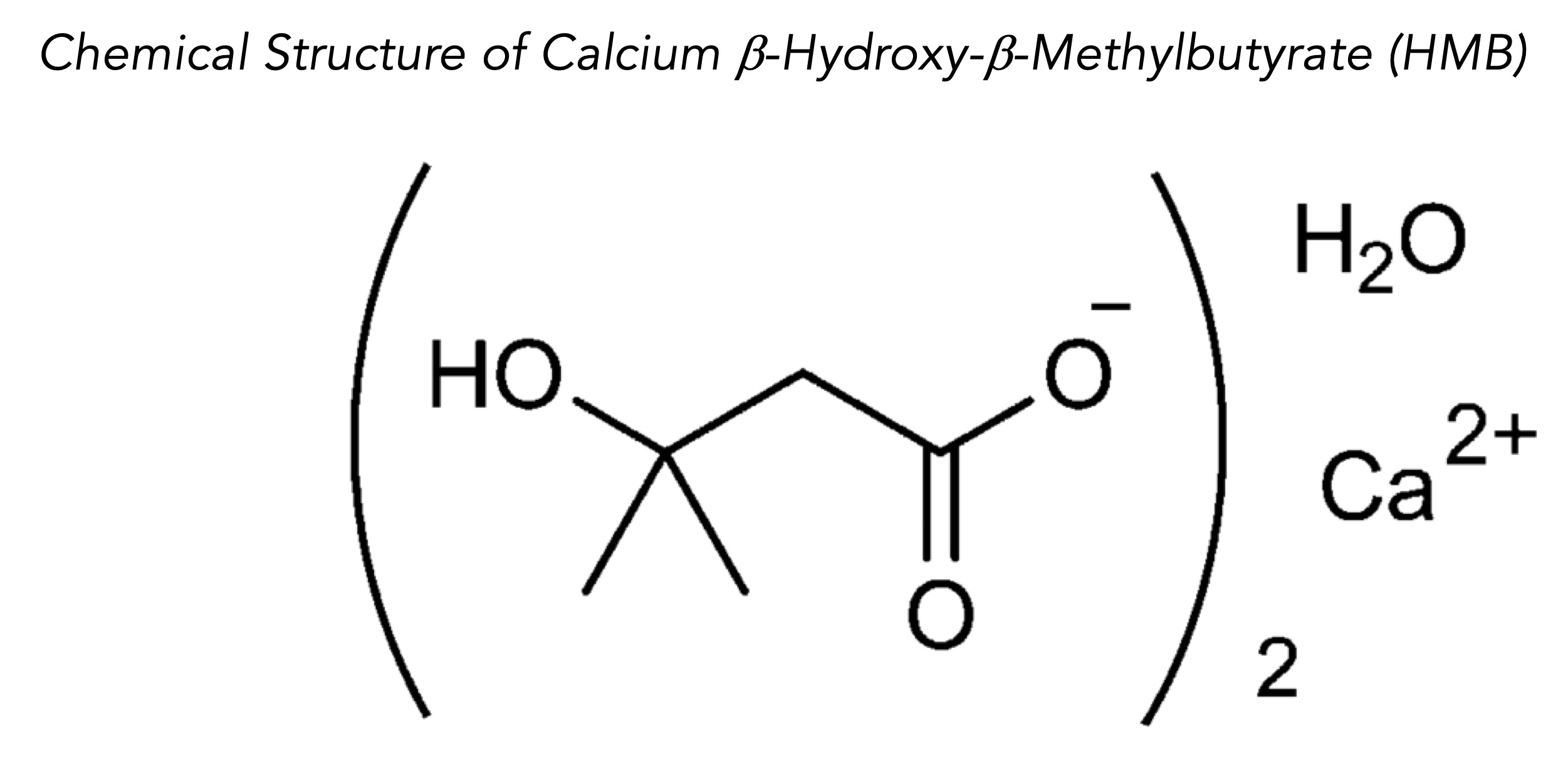
As a supplement, HMB has proven valuable for many athletes (those who participate in endurance and strength-power exercises). HMB has an anabolic (building up substance) effect on protein metabolism. HMB is derived from the essential amino acid leucine. Furthermore, in recent years, HMB has been studied for medical conditions where wasting away (Cachexia) and, as mentioned above, sarcopenia can hinder the quality of life in older adults.
Holeček (2017) reviewed the role of HMB in the supplementation of skeletal muscle and noted that HMB:
- Stimulates protein synthesis.
- Muscle protein breakdown is decreased.
- Increases mitochondria biogenesis and fat oxidation.
- Improves excitation-contraction coupling in muscle cells.
- Enhances tissue repair by increasing cholesterol synthesis.
- Reduces apoptosis of muscle cells.
- Improves tissue repair.
- Increases aerobic performance.
Vukovich et al. (2001) studied the effect of HMB and exercise in 70-year-old adults. The goal was to determine the effect of HMB supplementation in 70-year-old adults undergoing a modest exercise program for eight weeks (note that all subjects exercised, but one group received HMB and the other placebo). They found that HMB supplementation decreased body fat percentage while increasing fat-free mass. They also noted increased upper- and lower-body strength with HMB compared to controls. Vukovich et al. (2001) concluded that the mechanism of HMB is independent of age.
“Fearlessness is like a muscle. I know from my own life that the more I exercise it the more natural it becomes to not let my fears run me.” Arianna Huffington
HMB Treatment to Enhance Muscular Function in Older Adults: Recently, the use of HMB in older adults with reduced muscular strength, leading to sarcopenia, has been widely studied. Courel-Ibanez and colleagues (2019) reviewed the field of regular exercising and HMB supplementation separately to delay or reverse frailty and cognitive impairment in older adults. They note a gap of understanding in showing the benefit of HMB supplementation with physical exercise compared to exercise alone.
Rathmacher and associates (2020) performed a breakthrough study investigating the long-term effects of HMB and vitamin D3, with and without an exercise program, in a 1-year study with older adults (over 60 years). The overall study is described in the figure below:

There were four different treatment groups:
- Control and no exercise
- HMB and vitamin D3 and no exercise
- Control and exercise
- HMB and vitamin D3 and exercise
•The placebo was calcium lactate. The calcium HMB dosing (3 gm/day split into two doses plus vitamin D3 2000 IU/day) in the HMD supplemental groups. This is the typical HMB dosing schedule used in many past studies. Fuller and associates (2011) previously revealed the synergistic effect of vitamin D3 in combination with HMB for increasing muscular function.
•Body composition, vitamin D3 levels, and upper and lower extremities strength (elbow and knee) were measured at 0, 3, 6, 9, and 12 months.
•The exercise program was of moderate resistance training performed ~60 min per session thrice weekly.
•A total of 117 participants completed the study. Vitamin D3 levels remained steady throughout the study. Without exercise, HMB and vitamin D3 alone resulted in a more significant increase in overall strength compared to the control group.
•The HMB and vitamin D3 group with exercise was not further enhanced compared to the exercise-only group.
•HMB and Vitamin D3 were safe when testing kidney and liver function, blood chemistry, and lipids.
•Quaity of life was significantly increased for the HMB/vitamin D3 groups.
•The loss of functionality and skeletal muscle loss are hallmarks of adult aging. They can lead to sarcopenia if left unattended.
•These results highlight the benefits of HMB in the backdrop of adequate vitamin D3. The results here show that only a modest amount of exercise can do wonders for gaining strength; however, many older adults are either unable or unwilling to exercise.
“It is necessary to relax your muscles when you can. Relaxing your brain is fatal.” Stirling Moss
**HMB Treatment to Potentially Enhance Muscular Function in Parkinson’s: I have searched PubMed and Google Scholar for basic research and clinical trials using HMB and vitamin D3 with Parkinson’s, but I have not seen a study. However, one might consider trying HMB and vitamin D3 if you fit one of these categories: (1) over 60 years of age, and you have been told you have sarcopenia; (2) PwP over 60 years of age, and you feel listless and functioning weaker; (3) over 60 years old with Parkinson’s and have recently been told you have sarcopenia or frailty, or (4) PwP over 60 years old and unable to exercise. Or maybe you are like me, thinking about adding some functional muscle to my weaker right side while also trying to exercise in the middle of summer in South Carolina; it just feels okay to try it.
My strategy is based on the abovementioned: 3 gm/day Calcium HMB (two doses of ~1.5 gm in the morning and evening). I use BULKSUPPLEMENTS.COM HMB Powder – Calcium HMB (from Amazon.com, https://rb.gy/iyca6). Add 1/2 tsp of the HMB powder into ~4 ounces of cold water/Gatorade/Powerade and stir it to dissolve for ~15 sec. And once per day, vitamin D3. I am taking 5,000 IU NOW Supplements (from Amazon.com, https://rb.gy/t8j7j). I also do my usual stretching and exercise routines, play golf two days per week, and practice on the golf course driving range 4 days per week. Will give updates regularly to anyone interested and re-visit the blog story sometime in 2024.
**This blog posts contain advice and information related to health care. It is not intended to replace medical advice. It should be used to supplement rather than replace regular care from your neurologist. You should seek your physician’s advice/approval before embarking on any new health plan or changes to your existing plan/routine.
“Muscles come and go; flab lasts.” Bill Vaughan
Concluding Thoughts: The combination of HMB and vitamin D3 to build muscle and enhance muscular function has gone full circle, from athletes in training to now testing it to treat age-linked sarcopenia. So yes, HMB has proven helpful in published clinical trials for older adults. Maybe the idea of studying Parkinson’s linked to sarcopenia is gaining leverage; I do not know. And since HMB is freely available, pharmaceutical companies will likely not pursue its use. I am not suggesting you start taking HMB and vitamin D3. I am just providing background material describing its use.
Manini and colleagues (2013) published a fascinating paper dealing with the concept of aging and muscle. Their viewpoint was focused on the neurons and the decline in neurotransmission, especially related to dopaminergic neurotransmission. Their review suggests the explanation is more complex than simple skeletal muscle atrophy as we age (sarcopenia). Thus, HMB might not benefit PwP, mainly since our reduction of dopamine, and additional changes to the mid-brain, together participate in the faulty miscommunication of dopaminergic neurons in an older person with Parkinson’s. But then again, I could easily have misinterpreted this paper, and HMB may indeed bolster muscle function.
“Muscles are in a most intimate and peculiar sense the organs of the will.” G. Stanley Hall
References as Mentioned in the Blog Post:
Goodpaster, Bret H., Peter Chomentowski, Bryan K. Ward, Andrea Rossi, Nancy W. Glynn, Matthew J. Delmonico, Stephen B. Kritchevsky, Marco Pahor, and Anne B. Newman. “Effects of physical activity on strength and skeletal muscle fat infiltration in older adults: a randomized controlled trial.” Journal of applied physiology 105, no. 5 (2008): 1498-1503.
Cruz-Jentoft, Alfonso J., and Avan A. Sayer. “Sarcopenia.” The Lancet 393, no. 10191 (2019): 2636-2646.
Bianchetti, Angelo, and Andrea Novelli. “Sarcopenia in the elderly: from clinical aspects to therapeutic options.” Geriatric Care 5, no. 1 (2019).
Wu, Ying-Nong, Meng-Hsiang Chen, Pi-Ling Chiang, Cheng-Hsien Lu, Hsiu-Ling Chen, Chiun-Chieh Yu, Yueh-Sheng Chen, Yung-Yee Chang, and Wei-Che Lin. “Associations between brain structural damage and core muscle loss in patients with Parkinson’s disease.” Journal of Clinical Medicine 9, no. 1 (2020): 239.
Valent, Dora, Marina Peball, Florian Krismer, Anna Lanbach, Sophie Zemann, Corinne Horlings, Werner Poewe, and Klaus Seppi. “Different assessment tools to detect sarcopenia in patients with Parkinson’s disease.” Frontiers in Neurology 13 (2022): 1014102.
Cereda, Emanuele, Nicola Veronese, and Riccardo Caccialanza. “Role of muscle-targeted nutritional therapy: New data.” Current Opinion in Clinical Nutrition and Metabolic Care 25, no. 3 (2022): 142-153.
Holeček, Milan. “Beta‐hydroxy‐beta‐methylbutyrate supplementation and skeletal muscle in healthy and muscle‐wasting conditions.” Journal of cachexia, sarcopenia and muscle 8, no. 4 (2017): 529-541.
Vukovich, Matthew D., Nancy B. Stubbs, and Ruth M. Bohlken. “Body composition in 70-year-old adults responds to dietary β-hydroxy-β-methylbutyrate similarly to that of young adults.” The Journal of nutrition 131, no. 7 (2001): 2049-2052.
Courel-Ibáñez, Javier, Tomas Vetrovsky, Klara Dadova, Jesús G. Pallarés, and Michal Steffl. “Health benefits of β-Hydroxy-β-Methylbutyrate (HMB) supplementation in addition to physical exercise in older adults: a systematic review with meta-analysis.” Nutrients 11, no. 9 (2019): 2082.
Rathmacher, John A., Lisa M. Pitchford, Paul Khoo, Hector Angus, James Lang, Kristin Lowry, Carol Ruby, Alex C. Krajek, John C. Fuller Jr, and Rick L. Sharp. “Long-term effects of calcium β-hydroxy-β-methylbutyrate and vitamin D3 supplementation on muscular function in older adults with and without resistance training: A randomized, double-blind, controlled study.” The Journals of Gerontology: Series A 75, no. 11 (2020): 2089-2097.
Fuller Jr, John C., Shawn Baier, Paul Flakoll, Steven L. Nissen, Naji N. Abumrad, and John A. Rathmacher. “Vitamin D status affects strength gains in older adults supplemented with a combination of β‐hydroxy‐β‐methylbutyrate, arginine, and lysine: a cohort study.” Journal of Parenteral and Enteral Nutrition 35, no. 6 (2011): 757-762.
Manini, Todd M., S. Lee Hong, and Brian C. Clark. “Aging and muscle: a neuron’s perspective.” Current opinion in clinical nutrition and metabolic care 16, no. 1 (2013).
“Science explained people, but could not understand them. After long centuries among the bones and muscles it might be advancing to knowledge of the nerves, but this would never give understanding” E. M. Forster
Cover Photo Image by David Mark from Pixabay
 Journey with Parkinson's
Frank,
Thank you for a very timely post on HMB. Not sure if you have read a recent study on HMB and Alzheimer? In addition to muscle building, HMB may have cognitive benefit (at least in a mouse model of Alzheimer). See
https://www.medicalnewstoday.com/articles/could-a-bodybuilding-supplement-help-stave-off-dementia
https://www.cell.com/cell-reports/fulltext/S2211-1247(23)00728-3
LikeLike
Philip,
thanks for the note. I definitely saw and enjoyed the paper that was published in Cell reports by Paidi et al.,. Quite masterful work. I thought about including it, but decided a few days ago that the HMB story that I had developed was long enough. When I completed a few more searches, there was the story by Hempel et al. on PPARa and PPARg, and going back further to the story about cannabinoid work with cells. So I decided that a separate blog post on the role of peroxisome proliferator-activated receptors (PPARs) and their ligands on PArkinson’s would be written.It’s a new and very powerful story. And I really like this idea since it brings me back to an important part of my career. My first Komen for the Cure (breast cancer) grant was on the role of PPARgamma and obesity in promoting breast cancer invasion. I am very proud of the work done by Jennifer Carter in my research lab group where she earned her PhD at UNC on this topic: Carter, J.C. and F.C. Church (2009) Obesity and breast cancer: the roles of peroxisome proliferator activated receptor-γ and plasminogen activator inhibitor-1. PPAR Research. 2009:345320. Epub 2009 Aug 6. PMID: 19672469; Carter, J.C. and F.C. Church (2011) Peroxisome proliferator activated receptor gamma-ligands alter breast cancer cell motility through modulation of the plasminogen activator system. J. Oncology. 2011:594258. Epub 2011 Oct 29. PMID: 22131991; Carter, J.C., R.A. Campbell, J.A. Gibbons, M.W. Gramling, A.S. Wolberg, and F.C. Church (2010) Enhanced cell-associated plasminogen activator pathway but not coagulation pathway activity contributes to motility in metastatic breast cancer cells. J. Thromb. Haemost. 8(6): 1323-1332. Feb 24 2010 Epub. PMID: 20180817; and Carter, J.C. and F.C. Church (2012) Mature adipocytes promote breast cancer cell motility. Exp. Molec. Pathol. Jun;92(3):312-7. PMID: 22445926. Thanks again, I hope all is well for you? Frank
LikeLike
Frank,
Thanks for your interesting comment on PPARs. I know that PPARg regulates both lipid and glucose metabolism and has anti-inflammatory effects when activated. The precursor of the cannabinoids – cannabinoid acids (with a carboxy group attached) – are potent activators of PPARg. Nadal et al have shown that THCAA has neuroprotective properties. In addition THCAA does not activate CB1 receptors and therefore, unlike THC, does not have psychoactive effects. See https://pubmed.ncbi.nlm.nih.gov/28853159/
As always I appreciate all the helpful information you painstakingly put out.
LikeLike
Thanks, Philip,
I appreciate the comments. PPARs have come a long way in a short time. You are correct that they help control essential areas like glucose metabolism and have anti-inflammatory properties. It will be interesting to see if existing drugs that activate PPARg clinically will find another function in down-regulating Parkinson’s. Much potential, I think, but do these ligands get past the blood-brain barrier?
I look forward to relearning and getting up-to-date about the PPAR system of receptors and ligands.
LikeLike
Frank, thank you so much for this enlightening email. Although, as we’ve shared in the past, I am as active as anyone my age can be, regardless of age/disease. However, two things that I resonate with. My wife commented sometime back that my quads looked thinner. Second, I noticed recently when I swim laps I feel weak when I use a kick board. I’ve replaced the stretcher I was working with with a Personal Trainer who has trained many pros on the PGA. He put me through a full medical analysis and felt my muscle to weight ratio wasn’t where he expected it would be given my build and level of activity. IS there ANY concern of interaction with PEA?
LikeLike
Tommy, regarding your muscle-to-weight ratio. I am not a physiologist, so I do not know how fast something like this should change. I searched a couple of places today and found no harmful side effects of PEA on the muscles. However, we both take a mixture of reagents, and some combination of substances may have contributed to your muscle-to-weight ratio. If you are thinking its the PEA, then just stop taking it, and let’s see if things turn around quickly. I have always wondered and worried about taking all of these substances (And in the amounts we do!). It is like I decided to stop taking Ashwagandha due to its immune-modulatory properties, and I will await my next CBC with the next internal medicine physician (I’m still trying to find one I can work with in SC, what a pain-in-the-___!). Please keep me in the loop if this effect turns out to e PEA-driven. Good luck my friend, Frank
LikeLike
Thanks Frank, I appreciate all your efforts in creating your posts. Would you consider doing a post on creatine? I’d be interested in the same theme of increasing muscle mass.
LikeLike
Kai, in a 5-year study, creatine did not improve the outcome for progression of Parkinson’s compared to controls. Check out: https://www.ncbi.nlm.nih.gov/pmc/articles/PMC4349346/#:~:text=Among%20patients%20with%20early%20and,in%20patients%20with%20Parkinson%20disease. It showed a lot of potential pre-clinical but did not ultimately pass the test. But that is not to say one couldn’t use it for other purposes like build muscle. I will go back and re-review the story on creatine, and if there is any promising information, I’ll let you know, Frank
LikeLike
Thank you Frank., The PEA works so great I don’t want to give it up. I am thoughtful regarding any potential interaction between PEA and HMB. Thoughts?
LikeLike
Thanks Frank for such an interesting artic
LikeLike
You are most welcome, I enjoyed writing the blog post.
LikeLike
Frank,
My sister (PwP) was recently diagnosed with osteoporosis. This is especially concerning as PwP are prone to falls. Her endocrinologist recommended osteoporosis medications that have potential side effects that may exacerbate her PD stiffness and groin pain.
While researching HMB for my sister to retain her muscle mass, I accidentally discovered that HMB also acts as an anabolic agent for bone metabolism. So she is going to try HMB first before resorting to the medications recommended by her doctor. Below are some references for your interest. Thank you so much again for this very helpful post of yours. You are really helping the PD community a lot.
https://journals.lww.com/md-journal/fulltext/2017/10130/bone_mineral_density_changes_of_lumbar_spine_and.11.aspx
https://www.ncbi.nlm.nih.gov/pmc/articles/PMC8002460/
https://academic.oup.com/milmed/article/179/6/679/4160783?login=false
https://www.mdpi.com/2077-0383/10/21/4808
LikeLike
I look forward to her progress trying HMB, sounds interesting. Especially as osteoporosis is a fairly common problem. Good luck, and thanks a lot for the note and the references. Frank
LikeLike