

“Measure your success by your inner scorecard versus an outer one.” Robin Sharma
“I never keep a scorecard or the batting averages. I hate statistics. What I got to know, I keep in my head.” Dizzy Dean
The Reason for a Parkinson’s Disease Scorecard: We go see our Neurologist every six months, and one of their first questions is, “OK, what’s been going on? How are you?” Maybe you’ve got a detailed list of the significant events (Falling, stopped driving, etc.), but the day-to-day events, the arrival (and the advancement or changing) of new/old/routine symptoms that matter may be glossed over or not mentioned. And we all know there are over 40 routine symptoms that have been identified in Parkinson’s.
Therefore, would it help me/us to have a list of symptoms to check off daily? It gives you a synopsis of the past few months (one, three, six months, or an entire year). For example, it would be essential to report/describe events like dystonia, vivid dreams, loss of smell, and a growing loss of balance. This collection of symptoms would describe one’s Parkinson’s. It might provide the Neurologist with a better and more complete “picture” of our disorder, a route for treatment, and even a better gauge of our progression through this despicable disease.
“You could be winning and feel like you’re losing because the scorecard you’re using is unfair.” Tony Robbins
Importance of a Simple but Comprehensive List of Symptoms to Track: Students always copy their neighbor’s notes in a classroom. I always thought everyone was unique in taking notes and that no one else could interpret someone’s notes; however, sharing them was a nice gesture. So, in my ‘little mind,’ I have been thinking about what kind of list could be put into a day-to-day tracker that would be easy to fill out and comprehensive regarding its breadth of coverage of Parkinson’s.
Many Parkinson’s organizations suggest we should keep a daily diary of events. Where have I been for the past decade? Now, I agree. But how should this ‘calendar of symptoms’ be approached or made? Is it a blank page that requires one to write it all down? Should it be a more quantitative listing or description of symptoms, even using a 1–5 Likert scale (ranging from one strongly disagree to five strongly agree)? I compromised and did the following, as described below.
The Parkinson’s Daily Scorecard (PDS) is based on the following design as presented for just one issue in Parkinson’s, bradykinesia:
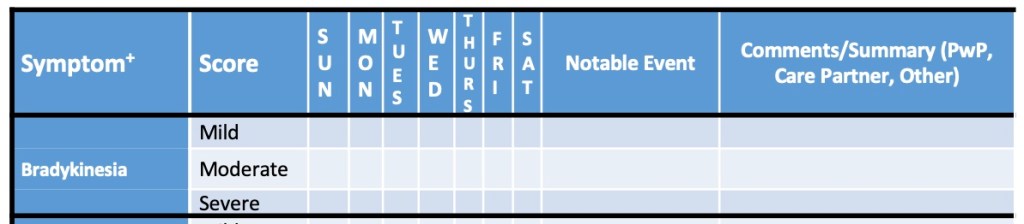
•I am convinced that everyone could devise a helpful event calendar to chart their disorder. But this is what I came up with, and hopefully, you’ll be able to use it or adapt it for your purposes.
•Besides listing the symptoms, I used a simple s•coring system for issues associated with the symptoms, using mild, moderate, and severe. I felt three choices were good enough to generate a pattern of pain or misaligned signals from our bodies.
•And it needed to be addressed every day of the week.
•There needed to be a place for noting the dates of key events and changes in your symptoms (for better or worse).
•There needed to be an area for comments from the person-with-Parkison’s (PwP), Care Partner, or someone else.
•Finally, I wanted to include about 25 of the most common symptoms of Parkinson’s and allow each PwP to modify/adjust/add other symptoms to ‘personalize’ their scorecard of Parkinson’s. Maybe you would need a scorecard with only 6-8 symptoms, more or less. Here is what the first page of 12 symptoms looks like; see below:

“Take less time to read the scorecard and more time to read the hole.” Chi Chi Rodriguez
The Parkinson’s Daily Scorecard (PDS): I will not ask you to share your information with me or anyone else besides your Neurologist. There is no ulterior motive to compile our answers for a comprehensive publication reviewing Parkison’s symptoms. However, the academic in me would have enjoyed writing such a study. I have enough going on; no, the PDS is for your use exclusively. However, if you use a better calendar of events to follow your Parkinson’s, please send it my way. I would then try to reoptimize this calendar/scorecard.
And what’s up with the score given for each week (tabulated at the bottom of each page every week)? Like the game of golf, every golf course has its par score based on the terrain and length of the golf course. I envision this weekly Parkinson’s score as your score, but only compared to yours. For instance, you may see a weekly score drop over time; that would be good news, and things are under control. If your score for a series of symptoms each week (comparing the first 12 symptoms, for example) remains the same, then that is a stalemate, which, in my mind, is still a good score. And finally, if, over six months, your weekly score is slowly increasing upward, then talk with your Neurologist about your symptoms.
This scorecard score is NOT anything like the unified Parkinson’s disease rating scale (UPDRS) that Neurologists use to follow the longitudinal course of Parkinson’s. The PDS is more like a personal scorecard of your understanding of symptoms and their presentation in each PwP. Thus, everyone’s score will differ due to the many symptoms associated with Parkinson’s.
“A tall, thin old man waving a scorecard from the corner of his dugout. That’s baseball.” Ernie Harwell
Describing the Parkinson’s Daily Scorecard (PDS):
For a 15-page handout for January 2024 in PowerPoint format (click here).
For a 15-page handout for January 2024, in PDF format (click here).
I am trying to convert the scorecard to a Microsoft Word format, so if you want that format, just let me know. For some reason, I made the PDS using Microsoft PowerPoint because I am just more comfortable making a Table in that format.
Pages 1 and 2 contain 24 of the most common symptoms of Parkinson’s. Page 3 is an open sheet with six spaces to add additional symptoms. Also, on page 3 are some comments about how to use the scorecard. Page 4 is a glossary of some of the medical terms used in the calendar. Pages 5-15 are simply the following weeks for January 2024 to give you a springboard forward to starting your personalized scorecard for Parkinson’s.
I imagine taking a few minutes daily to fill out the PDS would be best, likely no more than 5-10 min. Pick a time that best suits you to allow one to give your Parkinson’s some prioritized time to reflect and describe your disorder. I hope the PDS, or your personalized version, helps in some way to keep you in good health. Good luck and Happy New Year!
NOTE: Here is the glossary of terms (click here).
“The big question about how people behave is whether they’ve got an Inner Scorecard or an Outer Scorecard. It helps if you can be satisfied with an Inner Scorecard.” Warren Buffett
Cover Photo Image by Dimitris Vetsikas from Pixabay
 Journey with Parkinson's
Check out the app “PRO-PD” which permits the tracking of symptoms over time and generates a graph that helps identify progression of symptoms. Free application from Apple Store.
LikeLike
Frank,
You might find this article to be interesting.
Michael Hobert 24 East Main Street | Berryville, VA 22611 Phone: 540.955.4141 | Email: johnmichaelhobert@gmail.com The information contained in this e-mail message is privileged and/or confidential information intended for the use of the named recipient only. You are hereby notified that any dissemination, distribution, or copying of this communication is prohibited. If you have received this communication in error, please immediately notify the sender by replying to this electronic e-mail or call us at (540) 955-4141. Thank you.
>
LikeLike
Can you send me the article please?
LikeLike
I sent a huge attachment. I’m guessing you could not see it. Should I break up the article into pieces or do you have another way to suggest I send the article?
LikeLike
How about try sending it frank.church@gmail.com
LikeLike
Or just send the reference literature citation, I should be able to find it that way
LikeLike