

“The only living works are those which have drained much of the author’s own life into them.” Samuel Butler
“The greatest obstacle to discovery is not ignorance – it is the illusion of knowledge.” Daniel J. Boorstin
Introduction: Listed below are 20 topics related to Parkinson’s that I will likely write a blog post on in the coming months. I have spent the past few months reading, thinking, planning, and reading more. Part of this is a result of my Parkinson ‘s-related insomnia; after a while of not falling asleep, my brain is active, so why not just get up and read and think? The alternative is watching old episodes of either Battlestar Galactica or Yellowstone; all years of both shows are now available on cable TV. But first, a story about how I think and work is based on the following three quotes.
“A couple of months in the laboratory can frequently save a couple of hours in the library.” Frank Westheimer
Science and research are brutal and unforgiving. So much has already been done, so reading first to understand the science problem can save much time at the laboratory bench. It allows you to propose the ‘hypothesis’ of the story, what the science/research question is being asked about, and why it is essential. Thus, background reading is the foundation of your knowledge.
“The method in my madness” was first used by William Shakespeare in the play “Hamlet” where Polonius states, “Though this be madness, yet there is method in’t,” These words have been interpreted to mean that someone’s actions may seem unusual; however, there is likely a logical reason for it.
I always thought that I was competitive and could work very hard, but I never thought I was that intelligent. However, I always had a lot of ideas, and while most of them went nowhere, some had wings that lasted 4-5 years or more. A research laboratory in a U.S. medical school is like a small business; if you had the money, you could recruit people and do the science. Over the years, the lab group was each individually knowledgeable about whatever process I had proposed, and they were deeply intelligent and able to contribute to our overall success.
My training was in protein biochemistry. Our genes code information to make proteins. I started by digesting and chemically modifying proteins in blood clotting to see how they function. These tools evolved to include molecular biology and site-specific mutagenesis (that is, we synthesized and expressed modified proteins and compared their action to the original version (the wild-type). Then we added cells to the story, and since I was in a Pathology Department, we studied human tissues and then ultimately expanded to the mouse. The National Institutes of Health (NIH) and the American Heart Association funded the majority of this research for many years. And then Parkinson’s happened—the end of this research story.
The other main research story in my laboratory was focused on the role of proteases and protease inhibitors in breast cancer. We tested two hypotheses: that the tissue microenvironment created by obesity supported tumor cell migration and that these naturally occurring proteases and protease inhibitors participated in the invasion. We had two Komen for the Cure (of Breast Cancer) Grants that supported this research for several years. Ultimately, these grants ended, and again, Parkinson’s started to have a more prominent role in my life.
“It’s a delicious thing to write. To be no longer yourself but to move in an entire universe of your own creating.” Gustave Flaubert
“Down the rabbit hole” was first used by Lewis Carroll in “Alice in Wonderland. ” It usually describes someone getting absorbed by a topic or activity, even to the point of being distracted and losing touch with time.
My personality changes when I find an idea to read about, and my brain is engaged. It is not a healthy habit because I can sit for hours and work on an idea, write a blog post, or plan another paper to submit for publication.
“The writer must believe that what he is doing is the most important thing in the world. And he must hold to this illusion even when he knows it is not true.” John Steinbeck
The Reason This Blog on Parkinson’s Exists and Sustains Itself: Now, my focus is on exploring the complexities of Parkinson’s. While some of my blog posts may be better or more interesting than others, the common thread is my enthusiasm and effort in creating each one. My primary goal is to educate myself, and then share that knowledge with you.
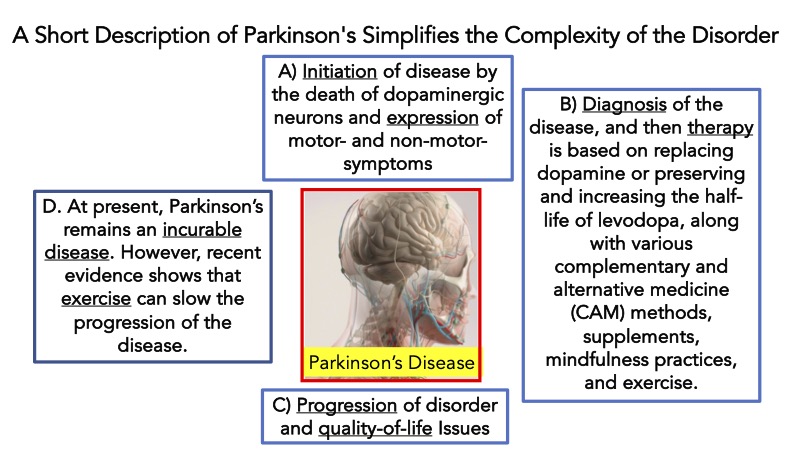
Below, you will find 20 topics that will eventually become blog posts. Additionally, I have provided a simplified description of Parkinson’s. The complexity of how the brain responds to the loss of dopaminergic neurons is not only fascinating; it is fundamental to understanding our lives with Parkinson’s.
- 1. Musculoskeletal Pain in Parkinson’s
- 2. Gait Disorders in Parkinson’s
- 3. Physiology of Human Aging
- 4. Disordered Executive Function in Parkinson’s
- 5. Differences in the Brain between Tremor- and Non-tremor-Dominant Parkinson’s
- 6. Neuroprotective Role of Melatonin on Sleep Disorders in Parkinson’s
- 7. Sleep Disorders in Parkinson’s and Can Sleeping on Your Back Promote Neurodegeneration
- 8. Role of Neurotransmitters in Neurodegenerative Diseases
- 9. Fifteen Additional Myths and Misconceptions About Parkinson’s
- 10. Changes of Brain-derived Neurotrophic Factor (BDNF) from Different Exercise Programs for Treating Parkinson’s
- 11. Understanding the Issue of Postural Instability (Balance) in Parkinson’s
- 12. Effect of Citicoline (Cytidine-5-diphosphocholine) to Increase Dopamine Synthesis
- 13. Role of Glutathione in the Brain and Another Look at Whey Protein Concentrates to Increase Glutathione Level in the Brain
- 14. An Overview of the “Imbalance Theory” in Parkinson’s
- 15. The Pro-inflammatory Effect of Excess Sugar Consumption on Parkinson’s
- 16. The Many Different Forms of Carbidopa/Levodopa in Treating Parkinson’s
- 17. Using Precision Medicine to Reversing Memory Loss in Neurodegenerative Diseases
- 18. Can Diet and Lifestyle Changes Reduce the Risk of Dementia in Parkinson’s
- 19. Understanding and Treating the Freezing of Gait in Parkinson’s
- 20. Total Hip Replacement (Arthroplasty) in Parkinson’s
“The secret of it all, is to write in the gush, the throb, the flood, of the moment – to put things down without deliberation – without worrying about their style – without waiting for a fit time or place. I always worked that way. I took the first scrap of paper, the first doorstep, the first desk, and wrote – wrote, wrote…By writing at the instant the very heartbeat of life is caught.” Walt Whitman
Cover photo word cloud created by Frank C. Church


Frank, I plan on writing a short synopsis on a little research I’ve done regarding autonomic dysfunction and the impact on the immune system. I’ve had asthma, virus, cold, etc for 5 weeks. Never lasted this long before. I hope it’s acceptable that I forward these musings to you. .
LikeLike
Hi Tommy, it is good to hear from you, it’s been a while. The topic of ANS dysfunction on the immune system is essential, and I look forward to reading your synopsis of what’s going on as it relates to you. (As I see it) The general problem with the immune system is that it erodes somewhat as we age, and that makes sense, someone who is 70 years old versus someone 30 years old that’s 40-years of work the immune system has undergone to keep one healthy. I hope this note finds you feeling better, and definitely, send me your document when finished. Frank
LikeLike