
“The greatest wealth is health” Virgil
“The first wealth is health” Ralph Waldo Emerson
Introduction: When I recently met my new Family Practice physician (the third one in less than 2 years), she said “My health was my wealth.” I left that medical visit with her comment stuck in my brain. Thus, the topic here, “Your Greatest Wealth Is Your Health,” had its genesis from this conversation.
“If you have health, you probably will be happy, and if you have health and happiness, you have all the wealth you need, even if it is not all you want.” Elbert Hubbard
The History of Our Health: We all have differences in our health histories. We likely have some similar experiences, possibly the flu, at some point in our lives. When we were young, maybe chicken pox, measles, and mumps; however, along the way, we developed other health-related issues as we aged. Others of you were probably perfectly healthy until your diagnosis of Parkinson’s. We could each come up with a list of health-related disorders we have had over the decades.
“Health is like money, we never have a true idea of its value until we lose it.” Josh Billings
The Current Status of Our Health: Where you are currently with your health is what matters most. I remember a recent conversation on the golf course with the three other guys in my group that day. We stood talking on the tee while waiting for the group ahead to hit their golf balls. And for some strange reason, we started listing our health issues. My list contained long-term lower back pain, many years of knee issues, a torn rotator cuff, a bad hip, and yes, I have Parkinson’s. Yet, overall, I still felt reasonably healthy, especially when there are worse possibilities and outcomes.
“The wise man should consider that health is the greatest of human blessings. Let food be your medicine.” Hippocrates
The Wealth Needed to Maintain Our Health: We are all different in how we pay for our health. I feel lucky in some respects. I have a State-managed retirement health insurance plan and medicare coverage from the U.S. government, And for forty years I lived in NC, where I had access to world-class health groups and organizations in Chapel Hill and Durham. My current healthcare station is okay, slowly improving, but the region is just not saturated with physicians. But overall, I am feeling better with time here in SC, knowing I still have past options back in Chapel Hill, NC, and new options in FL (Mayo Clinic and Cleveland Clinic), which are just 2-3 hours away.
Even with insurance paying for many of my visits, I still have co-pays varying from practice to practice. For example, since the spring through December, I have participated in the following: physical therapy on my hip (6 weeks, twice per week), MRI of my knee, arthroscopic knee surgery, 6 weeks of physical therapy for my knee (twice per week), a procedure done on my lower spine, a procedure done through my hip joint, an ultrasound of my kidneys, and coming soon, more physical therapy for my knee and hip, routine colonoscopy, and physician appointments with my Family Practice, physician, Orthopedic surgeon, Spine Orthopedic surgeon, Skin Cancer PA, Nephrologist, Gastroenterologist, and yes, even my Movement Disorder Specialist
“The only way to keep your health is to eat what you don’t want, drink what you don’t like, and do what you’d rather not.” Mark Twain
Our Health in the Presence of Parkinson’s: Clearly, I have some health issues on top of my daily dealing with that evil entity known as Parkinson’s. One cannot ignore other disorders while one deals with Parkinson’s; likewise, devoting too much time to the other disorders, ignoring Parkinson’s is a disaster waiting to happen. A balance somehow is needed. Most of the articles that describe the importance of your wealth as it relates to your health spend most of their time focused on the financial aspects of our lives. While I appreciate their remarks, what matters to me most is how to guide one to a productive, healthy life to reduce the impact of Parkinson’s.
“It is health that is real wealth and not pieces of gold and silver.” Mahatma Gandhi
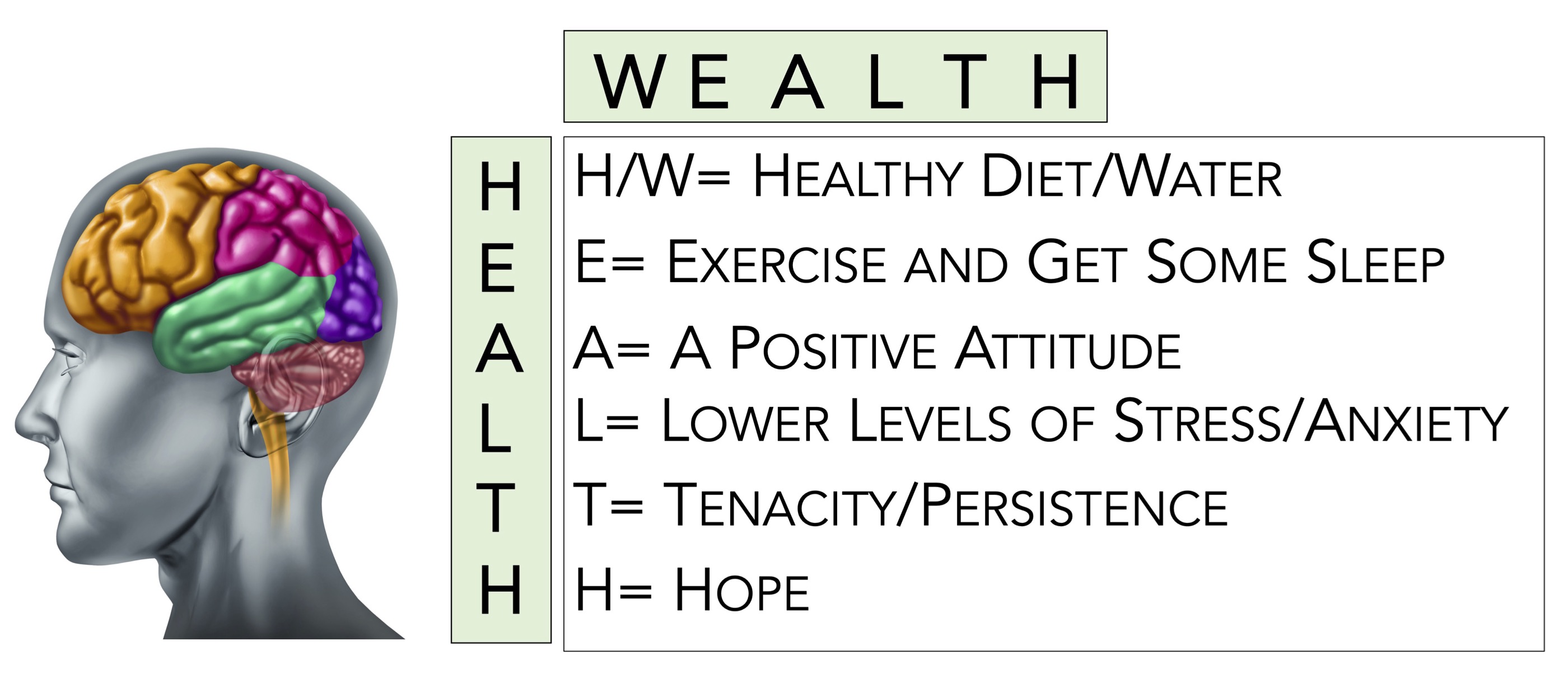
Some Important Aspects to Help Maintain Your Health, Especially in the Presence of Parkinson’s: You have read a lot of this material before; it is not rocket science. It is just practical information that we need to be reminded of more. This is the deal to maintain your health and make it your wealth, even in the presence of Parkinson’s (see the figure and text that follows it below). This list is just the start of managing your heath.

Click here to download a JPEG version of the figure.
•Healthy diet and drinking a lot of water- We probably do not discuss this enough, but eating a healthy diet is essential for maintaining health and fighting Parkinson’s. You must provide fuel for your body to generate energy and to mount an attack from within. Without a good diet, you’ll be susceptible to a more severe blow from your Parkinson’s. Which diet is best? If you can do it, think more of a Mediterranean-based diet. Also see this blog post, Diet and Dementia (Cognitive Decline) in the Aging.
And without a doubt, stay hydrated, drink water, and drink a lot of water daily. Every cell in your boy needs to stay hydrated, so drink water. Water is the primary component of blood, which carries nutrients and oxygen to cells, removes waste from the body, and helps maintain a constant temperature. Also see this blog post, Parkinson’s: The Importance of Drinking Water.
•Exercise and get some sleep: You already know the importance and benefits of exercise. We recently said: “One of the more important treatment strategies for PD is exercise [45,46]. Regular exercise is known to benefit the health of older adults through various physiological processes. These include improving insulin sensitivity, reducing body fat, increasing cardiovascular function, enhancing cerebral blood flow and oxygenation, and improving muscle mass and strength [47]. Physical exercise promotes the synthesis/release of signaling molecules termed exerkines [48-54], which exert their action through autocrine, paracrine, and endocrine processes.” [Mitchell AK, Bliss RR, Church FC. Exercise, Neuroprotective Exerkines, and Parkinson’s Disease: A Narrative Review. Biomolecules. 2024 Sep 30;14(10):1241. doi: 10.3390/biom14101241.] Time spent exercising will be rewarded in our quest to reverse the effect of Parkinson’s, but it takes time, effort, and dedication. I once said, “Exercise For Your Life: A regular aerobic exercise program likely helps to promote the appropriate conditions for the injured brain to undergo neuroplasticity.” From Déjà Vu and Neuroplasticity in Parkinson’s. Also see this blog post, The Importance of Exercise to Help Manage Parkinson’s.
And without sleep, one is facing a steep downhill slide toward illness in favor of Parkinson’s. But the path is rocky and hard to follow. As described by the Parkinson’s Disease Foundation (Sleep Disturbances ): “Most people with Parkinson’s find it difficult to sleep through the night. Rigid muscles, tremors or stiffness at night, or not being able to roll over in bed can all interfere with sleep, as can the frequent urge to urinate. In addition, many people with Parkinson’s experience vivid dreams or hallucinations and act out their dreams, violent nightmares, a problem called REM sleep behavior disorder.” You will have to sort it out with your Neurologist because you need to aim for getting some sleep, and hopefully better sleep that is restful and replenishing. Also see this blog post, Science Sunday: The Benefit of Taking Naps and Using Non-Sleep Deep Rest to Improve the Quality-of-Life in Parkinson’s.
•A positive attitude: I have always stressed that the way you feel about things instructs your body on how to receive and react to treatment. It is better to be positive when you get up against Parkinson’s (or whatever illness you are addressing) because when you know you will mount a strong and positive charge, you will. It takes strength, willpower, and a positive attitude to be formidable as Parkinson’s slowly moves against you. I once said, “There will be moments when you’re having a difficult time that your mindset turns negative; however, I believe that’s when you need to be most positive in dealing with Parkinson’s. Our lives are different now than they were before Parkinson’s and using positivity will allow us to creatively handle many obstacles ahead.” From Chapter 5: A Parkinson’s Reading Companion on Positivity
•Lower levels of stress/anxiety: There is that moment when a charcoal fire is going just fine in the backyard patio, and then someone comes along and sprays an extra dose of lighter fluid onto the burning coals. The effect is as expected: a massive flame of fire comes off the charcoal. Think of the charcoal flame going along just fine as life doing well with Parkinson’s. Now, think of the lighter fluid as a massive dose of stress/anxiety, and the flame is the result of your Parkinson’s flaring up. It is not easy, but if you can reduce your levels of stress and anxiety, it is better to control the outburst. When under extra stress or I am anxious about something, they both magnify my motor responses, tremors, speech, gait, and other things that are whacked out. Relieving the stress allows Parkinson’s outbursts to melt away and return to a more usual self. For many, work is the catalyst of stress (it was for me), and retirement is one answer. However, retired life is not without its unique stressors. All one can do is try to moderate your levels of stress and anxiety and try to reduce their impact on your Parkinson’s. Also see this blog post, Living Better with Parkinson’s.
•Tenacity/Persistence: The battle against Parkinson’s will not be easy, along with any other health issues you are dealing with. It could consume you and those around you. It would help if you were tenacious enough to withstand the blows of Parkinson’s. Your persistence will allow you to adjust to the slow and steady response of Parkinson’s to take over the control of your body. I said this, “Our most difficult life-challenges could create the greatest time of our lives. As President Coolidge remarked ‘Nothing in the world can take the place of persistence’ says to me we must always keep going in dealing with our disorder. No doubt this is a tough situation having Parkinson’s, but being persistent is not giving up without trying. Staying persistent is creating new options, and it continually requires the courage of one’s convictions.” From Hope, Courage, Persistence, Positivity, Mindfulness, And The Journey
•Hope: The final ingredient to keep your health is hope. Yes, it would help if you had hope. Never giving up, always remaining hopeful that a cure is on the way and that new therapies will evolve that allow us to be treated with the outlook of stopping the progression of Parkinson’s. I said this about hope, “For me, hope defined is the lighthouse shining bright on a starless beach at night. Hope is also a feeling when you read a science paper on Parkinson’s, that it’s a step in the right direction. From Where Does Hope Live? And I also said this, “The Cambridge dictionary defines hope as “the feeling that something desired can be had or will happen.” Hope is a key word in your life with Parkinson’s. A heart that feels hope keeps the body strong. A person that stays hopeful sustains their life for better-healthier moments.” From Staying Hopeful With Parkinson’s.
“Early to bed and early to rise makes a man healthy, wealthy and wise.” Benjamin Franklin“
Your Greatest Wealth is Your Health: Staying healthy is difficult. Keeping your health in sync with your life becomes more of a challenge as we age. My brain is now occupied by Parkinson’s, and my attempt to resist its influence is ongoing on a daily basis. We have the tools to fight off this and many other invaders, although these defense mechanisms may be functioning at <100% in older adults. Thus, it helps me to think about this list above to follow these lifestyle pointers to help me resist Parkinson’s. Stay healthy, it is a big part of your wealth. Also see this blog post, 7 Healthy Habits For Your Brain.
“Not enough of our society is trained how to understand and interpret quantitative information. This activity is a centerpiece of science literacy to which we should all strive-the future health, wealth, and security of our democracy depend on it. Until that is achieved, we are at risk of making under-informed decisions that affect ourselves, our communities, our country, and even the world.” Neil deGrasse Tyson
Cover photo credit Frank C. Church, “Sunny Day in Bermuda”
 Journey with Parkinson's